Wednesday, 20 August 2008

Red Angel (1966, Japan, Yasuzo Masumura)

Upon reviewing Masumura's 'Blind Beast' recently, I remarked upon how versatile a director he is, able to turn his hand at almost any genre and seemingly hop between them with ease, whether it be the lesbian melodrama of 'Manji' or the S&M infused amour fou of 'Blind Beast'. Between these films comes 'Red Angel', a strange black and white war film. One problem with being so versatile is that you spread yourself to thinly, don't always play to your strengths and fail to carve out your own niche or voice. My problem with the Masumura films I've seen, and I've enjoyed them on the whole is that I never feel sufficiently engaged. There's something unconsciously (for me at least) alienating about them and I never feel totally immersed in them. I wonder whether that's related to Masumura's desire to try his hand at various genres.

Starting with sounds of war (gunfire, bombing) over photographs of conflict, Masumura creates a powerful statement about the physical and psychological effects of war, specifically the Sino-Japanese war of 1937-1945. Masumura doesn't hold back in showing these horrors; soldiers are injured and in gruesome scenes which remind me of the surgery scenes in 'Eyes Without A Face', amputations without anaesthetic are the norm for those "lucky" enough to survive. This is a recurring issue here; whether these men would be better off dead than being amputees for the rest of their lives, isolated from mainstream society. Many of them long to be put out of their misery. Then there's the moral anguish of the medical staff who are responsible for these life and death decisions. Against this backdrop, Sakura Nishi (Ayako Wakao) is sexually assaulted by a group of soldiers. It emerges this isn't the first time that has happened, that all nurses are subjected to similar treatment and that behaviour of this kind is pretty much accepted and forgiven by the authorities. War is an unnatural state where social conventions and norms are rejected perhaps and in a world where death or severe injury is likely and human life has no sense of value, humanity falls by the wayside. I doubt this is any kind of excuse for this act, but might act as a sense of explanation for it.

Nishi's commitment to her cause forces her to make serious self-sacrifices - seeing a doctor's compassion but also his erratic behaviour, caused by his reliance on morphine to allow him to endure the horrors of the frontline, Nishi falls in love. At the same time, she tends to one severely injured patient in the most unconventional of means. Unable to relieve his own tensions (his arms were amputated - there's no doubt what he means), they start a short lived affair. These men are the desperate and the dying and Nishi considers it her duty to try to save them. When her lover dies, she blames herself and cannot forget, despite all the contrary advice she receives to think only of herself in this state of war. But the psychological scars don't heal. Proof that this conflict is too horrendous for anyone to possible bear is the outbreak of cholera that coincides with the massacre of the Japanese forces.

'Red Angel' is quite a struggle to get through; it's subject matter of amputation, drug addiction and gruesome conflict was probably just as groundbreaking and taboo-busting as much of Masumura's work at the time, but it also supersedes most other war films in that sense. Very few that I can recall have treated war in such an honest and depressing fashion, nor have they quite approached the subject of war in quite such a bizarre and peculiar way. It's beautiful and gruesome in equal measure with a dash of the erotic at the same time. Certainly unique, it's further proof of Masumura's talent, though I'm not convinced I've seen a truly great film of his yet. 3.5/5

Sunday, 17 August 2008

Seconds (1966, US, John Frankenheimer)

The third part of an unofficial 'paranoia' trilogy (which also comprised 'The Manchurian Candidate' and 'Seven Days of May'), 'Seconds' might well be one of the most downbeat films you're ever likely to see, but shows a remarkable insight into contemporary America through the eyes of a director that cinema history tends to ignore the achievements of; perhaps because he was never auteur material, perhaps also because of the poor films he was making at the end of his career. In my opinion, it's more satisfying and thrilling than 'The Manchurian Candidate' and is easily one of the most stunning films of its decade.

Utilising the immeasurable gifts of cinematographer James Wong Howe, who made 'The Sweet Smell of Success' look so bleak, Frankenheimer's masterpiece is dizzying and disorientating for the viewer - the constant use of fish eye lenses to create an impression of a world out its natural order, where nothing is as it seems, as well as extreme point of view filming methods, following individuals with intense close ups. The ominous use of these techniques in the film's opening scenes indicate straight away that we're being shown events where nothing will be normal and the tension never once lets up from this point.

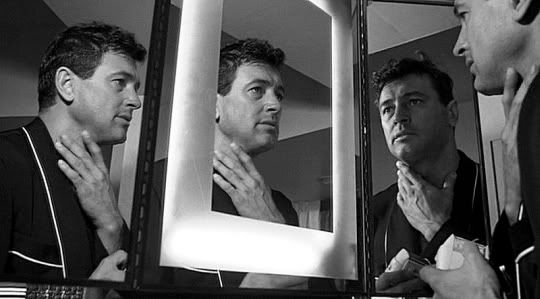
Arthur Hamilton (John Randolph) seemingly has the middle class American dream - a successful job, a wife and children, and a prestigious house in the suburbs. But at the same time, there are obvious cracks in the facade. His marriage is loveless and he barely communicates still with his wife, and his children have long since moved out and started out on their own adult lives. A peculiar incident in which he's given a piece of paper with an address piques his interest; it's for a company which can offer him what every middle aged American male wants - "real freedom". Hamilton is offered a chance to start over again - the company can fake his death, offer cosmetic surgery and set him up with a new life, the life he always wanted. And so he becomes Tony Wilson (Rock Hudson), a bohemian painter. However the cost of such a change is not just financial, but also psychological and emotional, as he struggles to adjust to his new life. Despite this freedom, Hamilton maybe starts to wonder whether it's all it's cracked up to be, and the consequences of not living this new lifestyle as it was intended are potentially dangerous.

Perhaps some aspects of 'Seconds' seem a bit quaint and dated nowadays - the party in which revellers dance around naked as if it were some cliched Summer of Love nonsense (but even this seems quite daring for a mainstream film of the mid-1960s), but that doesn't remotely undermine a stunning film that examines the frustrations and emotional lack in the white American middle class in such a frank and open fashion, certainly more insightfully than any other film of the age was prepared to do. The core values of this social class; achievement, prestige, success, the good life - these are all seen as not being enough for the individuals who reject this for the new life of freedom offered by "the company", though this freedom itself has conditions that are more than Hamilton can bear. A thriller that puts the viewer through the emotional wringer and which is constantly technically inventive, 'Seconds' is incomparable. 5/5

Tuesday, 5 August 2008

La Ronde (1950, France, Max Ophuls)

As alluded to in the previous piece, Ophuls' brief Hollywood career was completed after making 'Caught' and 'The Reckless Moment', but still at his creative peak, he resumed work in France, with 'La Ronde' being the first example of this. Based on 'Reigen', the play for Arthur Schnitzler which was banned for obscenity, a fate the film faced in certain countries, Ophuls weaves a mesmerising tale of a daisy chain of ten sexual partners (e.g. A sleeps with B, B sleeps with C, etc before returning back to A). Although Ophuls remains faithful to the original setting of the play, turn of the 20th century Vienna and scrutinises the sexual mores of society as well as its class differences, the crucial theme of the transmission of syphilis seems if not omitted, then underplayed, although this doesn't really undermine the satire too much.

One of Ophuls' masterstrokes is using the handsome and charismatic Anton Walbrook (most famous for 'The Red Shoes') as the film's narrator and master of ceremonies. An omnipotent presence over the events that unfolds, as well as influencing events to ensure the circle of lovers remains intact, he is the incarnation of our desire to know and dispenses romantic advice; "all are led the same merry dance, when love chooses its victims of chance". He initially sets up the whore with the soldier, then aids the pairing off of each subsequent set of lovers, all to keep the carousel going.

Ophuls shows how sexual impropriety crosses class boundaries; notice how the whore pairs off with both the soldier and the aristocrat, representing two arms of high society. The sole married couple both have affairs - as the husband says "marriage is a perplexing mystery" and perhaps the young gentleman who sleeps with his maid represents a sense of economic exploitation. Using typically elaborate camerawork, never more evident that the opening scene, unbroken for several minutes as it follows Walbrook's introduction and summation of the events at hand, Ophuls pans the camera in circular directions as if to denote the circular nature of the waltz of love. Good natured and whimsical, though no less specific in its observation of sexual attitudes of the time, 'La Ronde' is an enchanting cinematic experience by a film maker clearly on the crest of a wave. 4/5
'La Ronde' is released on DVD on 8th September from Second Sight.

Monday, 4 August 2008

Caught (1949, US, Max Ophuls)

Recently, I reviewed 'Letter From An Unknown Woman', a superior melodrama which remains probably the best of the four Ophuls films that I have seen. Made just a year after, 'Caught' was Ophuls' first attempt at making a contemporary American film. This too is another melodrama, but one that also acts as a scathing attack on certain American values of the era (materialism, ambition, success). Leonora Eames (Barbara Bel Geddes), Caught's heroine starts as a rather shallow young woman about to enter charm/finishing school, with the sole intention of developing the refined habits and behaviour that will snare her a rich, successful husband. She reads fashion magazines, and romantically yearns for the good life. Naturally, her dreams becomes more of a nightmare.

Leonora meets and falls in love with Smith Ohlrig (Robert Ryan), a ruthless businessman with emotional and physical health issues. He's not so keen, but just to spite his psychoanalyst, he marries her regardless. Marriage isn't what Leonora expected it to be. Her charm school education is no use to her now. A man used to winning (who has heart palpitations when his superiority is threatened), Smith humiliates her in front of their friends/colleagues and wants to do his best to ruin her, ruling over her like a tyrant.

Escaping his clutches, she takes a job as a receptionist for the kind and self-sacrificing Dr Quinada (James Mason), and their attraction is mutual. However, when Smith finds her and wants her back (he can't accept losing her), Leonora is torn between the two men. Her yearning for a good life, for wealth, security and status take priority over love, though the crucial aspect is the fact she's pregnant with Smith's child and that Smith threatens a divorce citing adultery, giving him custody of their child, so perhaps Leonora is learning that her shallow ideals aren't what they're cracked up to be. Her eventual freedom is obtained in the most ironic of fashions, though not without a huge degree of tragedy, and what there is resembling a "happy ending" is incredibly subdued.

Like his fellow German, Douglas Sirk, Ophuls utilises the melodrama genre to raise significant and salient points about typically American values, increasingly held by many during a period of economic prosperity. Smith, unrestrained capitalism in human form is a cruel and merciless creature, who can't accept defeat and who must master others. Leonora's desire of Smith's world and her idealised notions of success and wealth display a sense of ambition that becomes her downfall. Only with the compassionate Quinada does Leonora find happiness, which refutes every ideal she previously held, although she struggles to let go of Smith's world. One wonders though, whether like Sirk's films, the satirical angle of 'Caught' was obviously noticed by its audience or whether it was just treated as a domestic nightmare and nothing more. Ophuls, who uses camera movement better and more interestingly than most, uses his technical gifts to show Leonora's world of peril - look at his use of lighting too when Leonora is faced with the moral dilemma of saving Smith's life when he has a heart attack. It would be so easy to let him die so she can be free and the contempt on her face is obvious, but Ophuls rejects such simple plot developments. 'The Reckless Moment' was made the same year, and should be considered together as incredibly pertinent dissections of contemporary American mores. 4/5

'Caught' is released on DVD on 8th September from Second Sight.

Monday, 28 July 2008

Day of Wrath (1943, Denmark, Carl Theodor Dreyer)

Made during the Nazi occupation of his native Denmark, Dreyer's film uses the concept of persecution and witch-hunting during the 17th century as an allegory for the situation his country found itself in at the time the film was made. Who knows whether the Nazis were aware of Dreyer's intentions; you'd think the production would have been closed down if it was that obvious, but such is Dreyer's subtlety that perhaps those for whom the film was an attack upon failed to notice the point. Set around 1623, where a strict Lutheran orthodoxy led to the persecution of Catholics and other non-Lutherans in Denmark, Dreyer shows a community that is paranoid and distrustful of others, always quick to point the finger and accuse those who act outside of the norm as witches - a crime of course punishable by torture and death.

An elderly woman is accused of being a witch, a crime she vehemently denies. In what is assumed to be a reference to the Nazis, brutal methods are used against suspected criminals; in order to force a confession, torture is used, and even this isn't enough - the authorities want the woman to denounce others. Of course, she knows of one witch and the confession of which would cause shock waves throughout the pious community. An elderly pastor, Absolon (Thorkild Roose) has recently taken a young second wife, Anne (Lisbeth Movin), much to the disapproval of his mother (Sigrid Neiiendam), and it was suspected that Anne's mother was a witch, only saved from the flames by Absolon's testimony, though one suspects whether she was saved solely to win Anne's heart. Therein lies at heart the hypocrisy of the community, where the power that resides in a small religious few can be manipulated and exploited for cynical purposes.

When Martin (Preben Lerdorff Rye), Absolon's son from his first marriage returns to his family home, the focus shifts from interrogating suspected witches to the actual existence of a witch in the community. Martin and Anne begin to fall in love, their idyllic happiness at their love blossoming (shown in rural scenes of walks and boat journeys) contrasting sharply with the world of paranoia and persecution that Absolon inhabits. Martin is more sombre and distant by his betrayal, acknowledging his sin, but the affair makes Anne more assertive. Even Absolon and his mother notice the change. Note how she wears her hair loose now, opposed to tied back in an austere fashion. Such is Anne's desire to be with Martin that she wishes her husband dead, a wish that indeed comes to pass. Whether this is an absolute statement on Anne's power or whether it's ambivalent due to his age, it's a statement later used against her when Anne is accused, like her mother, of witchcraft.

Dreyer uses the concept of religious dogma run amok to create a haunting and atmospheric world, filmed where those with power can manipulate and persecute others for their own ends. The obvious reference to the Nazi occupation of Denmark has subsequently been made – little wonder therefore that Dreyer fled to Sweden not long after the film was made. Much like in Dreyer's 'The Passion of Joan of Arc', Dreyer has a trademark of close ups on faces to show anguish and emotion - just watch how close he gets to the elderly lady denounced as a witch during her suffering, as well as Anne's face during her growing love for Martin. Dreyer learned his trade during the years of silent cinema when an actor's face could convey just as much as dialogue, so it's no surprise that he uses this form of expression so convincingly. The film's climax is as ambiguous as much of what we've seen before - whether Anne is a witch or not, despite her confessions is probably open to debate, but this shouldn't distract us from Dreyer's true aim perhaps - depicting an austere world of terror and fear. 4.5/5

Saturday, 26 July 2008

La Antena (2007, Argentina, Esteban Sapir)

Argentinian cinema is appearing more and more on the world stage at the moment. Pablo Trapero's 'Leonera' and Lucrecia Martel's 'La Mujer Sin Cabeza' were both in competition at Cannes for the Palme D'Or, and Lucia Puenzo's 'XXY', a sensitive portrayal of the life of a teenage hermaphrodite secured a British cinema release earlier in 2008 (a film I had quite a lot of time for too). 'La Antena', a throwback to the days of silent cinema and more accurately German expressionism was too released in May in cinemas. It's an intriguing commercial decision certainly, because it's essentially a silent film in black and white which shuns modern cinematic conventions, uses hand made effects rather than CGI and would sit comfortably with more the surreal films of the 1920s - just see how the film begins with fingers hovering over a typewriter, with piano sounds being heard. It's certainly the kind of film that won't be sought out by multiplex audiences.

The narrative itself plays second fiddle to an extent to Sapir's technical brilliance because it really doesn't hold the imagination that much. This is a city where no-one has a voice, where life is controlled by the hypnotic draw of television, and where some plucky central characters try to break this spell and liberate the inhabitants of the city. It's the kind of set up that has been done before, mostly in the world of science fiction, and to an extent in the films that Sapir seeks to draw inspiration from - there's a homage to 'Metropolis' in one scene, a film which has a similar plot to this one. Whether Sapir seeks to make any pertinent points about television as a tool that makes people docile and is used as a means of suppression in contemporary society, I don't know or maybe it's just a convenient enough basis for him to explore his imaginative visual ideas. Also, there's the significance of people literally having no voice - does this refer in any way to Argentinian history, where democracy has often been precariously placed and replaced by military rule/dictatorships in the past? Again, allegorical interpretations of 'La Antena' can be made, but such is the emphasis on the aesthetics of the film that you'd be forgiven for wondering this was Sapir's intentions.

I've no idea what kind of budget Sapir had to work with on this film, but as I assume it was minimal, he certainly stretches it a long way. We're used to watching modern films with gigantic budgets and you think to yourself "where did the money go"? Not so with 'La Antena', where you think completely the opposite, how did Sapir manage to achieve this with barely any financial assistance. Sapir clearly has an active imagination, a rich sense of film history (see his tribute to 'A Trip To The Moon') and a willingness to put his ideas on celluloid without any doubts. His use of subtitles for instance are different - I suppose they're aiming to be like intertitles from silent cinema, but they completely reflect every word that's said, rather than just the gist of a conversation, but they also leap from the screen. Sapir's world is also completely artificial, deliberately so. See how his distance shots of the city are clearly made from paper, but constructed to look effective as well as how such things would have been filmed in yesteryear.

Sapir is certainly a film maker of some promise and it will be interesting to see which projects he works on next. 'La Antena' is a feast for the eyes for sure and an imaginative piece of work. I'm not sure however that the narrative is much more than a slight premise for Sapir to get his ideas on screen, and that's fine - he clearly had to work with limited resources and 'La Antena' is more than the sum of its parts. Sapir's film has been likened to the work of early Tim Burton, but if we're thinking contemporary kindred spirits, then Guy Maddin is perhaps a more natural comparison and who knows whether his work has been an influence as he draws direct inspiration from surreal and expressionist cinema. 3.5/5

'La Antena' will be released on DVD on 18 August from Dogwoof Pictures.

Tuesday, 22 July 2008

Ikiru (1952, Japan, Akira Kurosawa)

Although much of Kurosawa's reputation rests with his samurai films and Shakespeare adaptations, it's easy to forget that before he concentrated on these genres, he was quite an adept director of contemporary films with a human conscience ('Drunken Angel', 'Stray Dog'). The finest example of such films is 'Ikiru', which in my opinion is his most complete masterpiece along with 'Ran'. If you take the basic set up; a mid ranking civil servant who has achieved nothing in his life discovers he's dying and wants to undertake one task of communal benefit, with modern eyes it seems a bit contrived, with the potential to finish the wrong side of sentimental. However such is Kurosawa's sincerity and empathy with his subject that the film emerges as a genuine triumph of human endeavour and an affirmation of life.

Acted by Takashi Shimura (one of Kurosawa's most frequent collaborators), Kenji Watanabe is a "mummy", someone who's been more or less dead for thirty decades, living for the minor achievements he's managed to accomplish, namely never taking a day off sick. It's a powerful performance, rarely relying on speech for Watanabe communicates purely in mumbles - it's all in the facial expressions. And that's part of the joy of 'Ikiru', how human faces drive the film as if it could be a throwback to silent cinema. Note how a drinking companion of Watanabe himself barely talks, just throwing quizzical looks in his direction.

Kurosawa doesn't keep us in suspense about Watanabe's health, explaining through voice over before the man himself knows, that he's dying from stomach cancer. Maybe this fact is laced with irony given that he never sought medical assistance for any illnesses in the past because he was too concerned that taking time off work would somehow be a dereliction of duty. Kurosawa then shows how Watanabe has got to the stage he has with flashbacks to his past - his wife died moderately young, leaving Watanabe to raise his son alone as he never remarried. These memories are what first springs to mind upon finding out about his impending death when he embarks on a period of soul searching (which includes copious drinking and skipping work), which then finally gives way to a moment of self-realisation - that life is short and he has to rescue the abandoned plans to build a children's playground in a poor part of the city.

Watanabe is just one part of the bureaucratic minefield though. When the local citizens first petition the council for the playground, there's an amusing scenario in which they are passed from one council department to the next before finally ending up back where they started (Public Liaison, which Watanabe heads) several hours later. Even when the playground has been completed, council departments all claim responsibility, sidelining Watanabe's efforts, especially the cynical and unscrupulous deputy mayor who has one eye on his forthcoming election. At his wake, prompted by the local citizens who mourn him, comes an acceptance that Watanabe was chiefly responsible for the playground's construction, and inspired by his zeal, his colleagues vow to follow his lead. Of course nothing changes - people are shown being passed from one department to the next in the very next scene.

Much like in the later work of Ozu, tensions between parents and children in post-WW2 Japan are apparent. In 'Tokyo Story', when the elderly parents from the countryside visited their city dwelling children, they had no time for them and regretted this when they passed on. The same occurs here, where Watanabe's selfish son and daughter in law are interested solely in Watanabe as a source of money - he overhears them discussing his retirement bonus and he subsequently neglects to tell them he's dying. Respect amongst the younger generation for their parents and elders appears to be lacking in both films and continued to be an issue in the works of Ozu for instance.

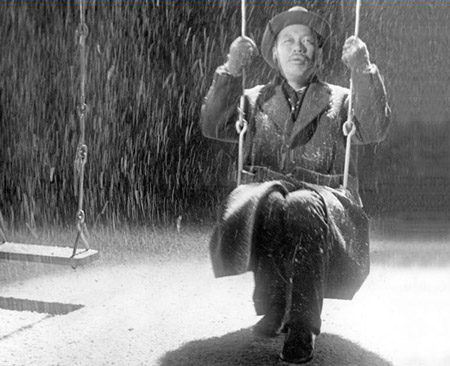
As typified in the iconic scene of Watanabe sitting on the swing in the playground in the snow, cooing a 20s love song as he awaits death, 'Ikiru' is one of the most profound and moving films anyone is ever likely to see. Thanks to Shimura, Watanabe convincingly transforms from a man whose entire life had been meaningless and unfulfilled to a man whose death-inspired zeal and determination was able to achieve something positive for the common good. Kurosawa's empathy for the man is evident and its this which allows the film to remain honest and not feel forced or manipulative, as well as offer substantive insights into the human condition. 5/5