Monday, 21 July 2008

The Red Shoes (1948, UK, Michael Powell/Emeric Pressburger)

Justifiably selected as one of the ten best British films of all time in a recent BFI poll, 'The Red Shoes' is a dazzling reminder of the golden age of British cinema and perhaps the most famous example of the brilliance of The Archers production team (Powell and Pressburger). It's a film that works superbly on both a narrative and visual level - on one hand it's a moving melodrama about a dancer torn between her love for her art and her love for her partner, whilst on the other it was like nothing British audiences would have seen at the time, a dizzying explosion of colour and expressionism. Little wonder therefore that Martin Scorsese cites it as one of the most influential films upon his career.

Victoria Page (Moira Shearer), a humble dancer in the Lermontov ballet troupe is discovered by the driven yet charismatic Boris Lermontov (Anton Walbrook) and made a star of, whilst simultaneously falling for the composer Julian Craster (Marius Goring). However in true melodramatic fashion, one can't have what one both loves, and Victoria has to make a choice - to marry the love of her life, or become a slave to her art. Add into the mix the ballet of The Red Shoes itself, based on the Hans Christian Andersen tale about the girl whose shoes would not allow her to stop dancing until tragedy struck. Victoria's life ultimately is fated to echo hers. Whilst this has the potential to sound a little contrived and unoriginal - the love triangle dimension has been done before (though this is love between a man and one's art), it's handled so confidently by film makers at the peak of their powers, it's always convincing.

Most discussion about the film rightly rests with its visual brilliance. Consider that the norm for British made films was to use black and white stock; very few films had been filmed in colour by the late 1940s. 'The Red Shoes' was something different, something new. The eye-popping use of colour would have been a revelation. The ballet sequences are a masterful example of expressionism, with Victoria's fragile psychological state laid bare for us to see. As she takes off in 'The Red Shoes' ballet, the theatrical setting transforms into something much more dreamlike and artificial, with Victoria floating in space whilst seemingly hysterical and traumatised by the prospect of being torn between Craster (love) and Lermontov (art). This sequence exists as a microcosm of the film's visual artistry; an assault on the viewer's senses, but the film is much more than that. It's a demonstration of British cinematic confidence during its peak by arguably it's finest film makers. A masterpiece. 5/5

Blind Beast (1969, Japan, Yasuzo Masumura)

Diverting exploitation fare from the versatile Japanese director Masumura (who made the Frank Tashlin-esque 'Giants and Toys' and the lesbian melodrama 'Manji' amongst other films), which must have seemed pretty out there to late 60s Japanese audiences, though it fits into quite suitably amongst the new wave of films during that period. Coming over as a precursor in many ways to Nagisa Oshima's 'In The Realm of the Senses', which followed a few years later, 'Blind Beast' focuses on an equally sordid affair based upon seemingly S&M ideals.

Aki (Mako Midori), a spunky young model, poses for some fairly kinky "artistic" photographs which are shown in an exhibition alongside a life sized clay model of her body. When she visits this exhibition, she sees a young blind man caressing this model in a way that doesn't seem natural. Of course this concerns her as the man's hands running up and down the clay model are practically felt by her, as if it is her body that is being fondled. The same man, Michio (Eiji Funakoshi), turns up later as her masseur, kidnapping her with the help of his mother. Thus begins a perverse episode as Michio first forces Aki to act as his model for his new artistic endeavour, though their growing closeness causes a rift between Michio and his domineering mother.

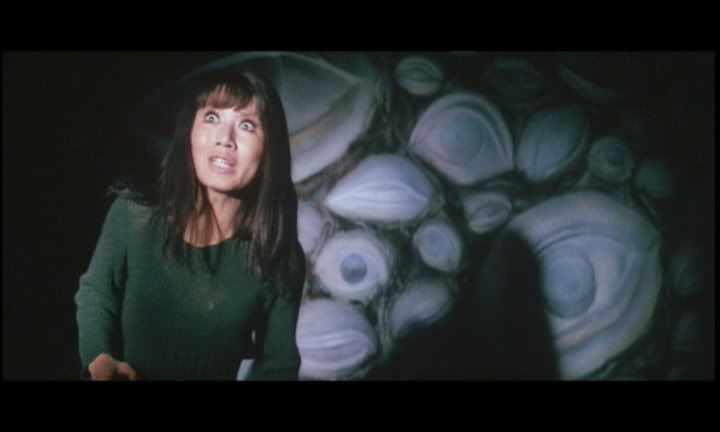
Although the narrative and drive of 'Blind Beast' barely stays together, Masumura's handling of this slight material is enough to make it more than watchable. The film's real success is in its set design. Michio's studio is a terrific recreation of his sensory capacity; with walls adorned with body parts and sensory functions - eyes, noses, breasts, arms (like those in Cocteau's 'La Belle et Le Bete' or Polanski's 'Replusion', though motionless). It's so elaborately designed, you can't help but watch with wide eyed wonder. There's amusement to be gained from Aki and Michio's initial cat and mouse games through large nude models. Michio explains his motivations for his studio's design and kidnapping of Aki - that he has senses other than sight, that touch is the only sense that means anything to him.

The kidnapping also reveals Michio and Aki's nascent interest in power games and sexual quirks - his sadism, her masochism ("I only like it when it hurts"). Michio's sexuality had been repressed before, with a creepy Oedipal complex apparent, but he's now liberated by not only his mother's death, but Aki's acquiescence towards his sexual desires. When she loses her sight from the near darkness in which she resides, they share the ecstasy of caresses, of achieving sexual gratification through touch only. As the violence inflicted upon each other increases to achieve enjoyment or "exquisite pain", there's not much territory to explore, and explore they do, with the final sexual ecstasy achieved through cutting of limbs, symbolically shown through the falling of a clay statue.

In many ways, 'Blind Beast' is rather ridiculous; a kinky little film that's actually quite chaste in what you see, but the exploration of more intense sexual adventures was rather groundbreaking and laid the path for the more notorious 'In The Realm of the Senses' as mentioned above. I guess if anything, the S&M infused affair is related to the sensory (lack of) capacities of Michio and Aki, that by lacking certain senses, they have something to make up for, which manifests itself in the methods they use. Not that it should be taken too seriously though, and it might easily be forgettable if not for the fact that Masumura knows what he's doing and the use of an elaborately designed set to highlight Michio and Aki's sensory and sexual issues. 3.5/5

Monday, 14 July 2008

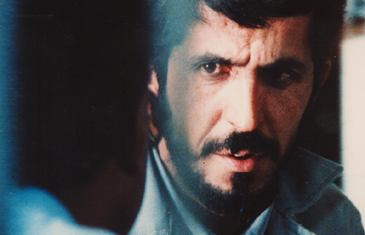
Close Up (1990, Iran, Abbas Kiarostami)

One of the earliest features that brought Kiarostami to the attention of Western critics (indeed this was one of Cahiers du Cinema's top five films of 1991), 'Close Up' is a curious film that is based on a real life incident where a man named Hossain Sabzian was initially mistaken for the Iranian director, Mohsen Makhmalbaf, but then assumed his identity to immerse himself in a middle class Iranian family's house and lives for no obvious reason. The stylistic conceit here is that Kiarostami films partly in documentary style and also partly as a standard re-enactment of events with the real individuals involved (thus you have Sabzian repeating his fraud over again and so on). Kiarostami himself films the trial of Sabzian (which apparently isn't standard practice - even the judge wonders why he's filming such a trivial case given the standing of him as a film maker) and a journalist (Hossain Farazmand) who wants to understand the whole incident.

Thus what Kiarostami presents us with is a world where nothing is quite as it appears. The lines between fact and fiction become blurred, especially in the mind of Sabzian who maintains the pretence that he is Makhmalbaf. Kiarostami has always shown an interest in "cinema" in his films - his later 'Through the Olive Trees' was about the making of an actual Kiarostami film in many ways. Is Kiarostami suggesting cinema is a chronicler of real life (hence the pseudo-documentary nature of them) or that they're distinctive entities? The media are partly shown to be culpable for the fraud of Sabzian too. Their constant reporting on Makhmalbaf surely made his life appear glamorous to Sabzian and therefore encouraged his deception when the opportunity arose.

Sabzian's motivations though aren't nefarious - he is a poor and humble man whose wife has left him and he lives with his mother. He has no hopes and ambitions and contemporary Iranian society has no obvious place for him. He has no job and self-esteem and admits that the fraud gave him the only chance in his life to feel important and to be respected - people actually listened to him and his opinions. Sabzian (as Makhmalbaf) explains that he is visiting a family because directors should show humility and live closely with those people he wishes to film. Sabzian is a man who would live a normal life if given the chance. His fraud was born out of desperation. Kiarostami's ultimate display of sympathy is one of the final shots of the film, as he rides with Sabzian on a motorcycle before visiting the man he impersonated. 'Close Up' is a shining example of Kiarostami's humanism and another superb demonstration of his interests in the distinction/convergence between cinema and life. 4.5/5

Days of Heaven (1978, US, Terence Malick)

Terence Malick is one of the very few great contemporary American film makers. I know it's easy to suggest a director has never made a creative mis-step when his entire career only exists of four films, but it's still the case that all of Malick's films to date could be described as masterpieces by any yardstick. 'Days of Heaven' is in my opinion though, the finest of all. It's odd that for all the talk of a new Hollywood generation in the 70s, Malick often goes unnoticed and seldom mentioned in the same breath as his much more highly regarded contemporaries such as Scorsese and Coppola - time to set the record straight, I think. 'Days of Heaven' is easily the match of their greatest works ('Raging Bull' or 'Apocalypse Now' say).

Set in 1916, Malick traces the tale of three itinerant workers (Bill - Richard Gere, Abby - Brooke Adams, Linda - Linda Manz) who escape to Texas after Bill murders a co-worker. They end up working for a farmer (Sam Shephard), who Bill learns is dying. Knowing that the farmer is in love with Abby, they hatch a foolproof scheme - if Abby marries the farmer, then when he dies, the three of them will be set up for life. Of course in cinema, the best laid plans never succeed, and so it goes. The plan is jeopardised on two fronts; the farmer shows no sign of becoming more ill and that Abby begins to fall in love with the farmer. Bill and Abby had been passing themselves off as siblings, when of course they're more intimate than that, and whether the farmer suspects or not (his foreman does though the farmer fires him when he raises his concerns), what results is a tumultuous jealousy from both men as they are unable to wholly love the woman they are in love with, which naturally results in tragedy.

Most critics praise 'Days of Heaven' for its visual rush, and it's certainly true that the Oscar-winning cinematography of a near-blind Nestor Almendros (known for his work for Francois Truffaut) and Haskell Wexler paints an evocative image of the rural South. It's one of the best looking films you'll ever see, up there with 'The Red Shoes' or 'Barry Lyndon'. The film is much more than a superb demonstration of visual style though, as the moral implications of Bill, Abby and Linda's plan unfold in a jealousy-soaked climax of literally Biblical proportions. Two prominent references to the Bible are used in the film - Bill and Abby passing themselves off as siblings reflect the same circumstances of Abraham and Sarah, and also the Plague of Locusts from Exodus is used as the farmer's wheat fields are ravaged; the trauma of which directly drives the tragic stand-off between Bill and the farmer. Malick disappeared from film for two decades after the post-production of 'Days of Heaven', which reportedly itself took two years to complete. We should be fortunate he returned to film making. 5/5

The Damned (1969. Italy/West Germany, Luchino Visconti)

'The Leopard', widely regarded as Visconti's finest film charted the decline of an aristocratic family during the rise of Garibaldi and Italian nationalism. It was sympathetic towards its main characters who were swept up by events and the inevitable course of history. 'The Damned' is thematically fairly similar. A German industrialist family, the von Essenbecks (rumoured to be based on the Krupp family) align themselves with the rising force of Nazism and find their own existence torn apart by family friction and divisions as Nazism takes control of German society. This is one dysfunctional family where you feel absolutely no sympathy with anyone as each jockeys for position and favour with the Nazi elite, each tries to set the other up, and where sexual abuse and immorality is the norm. It's now common for Nazism to be related to sexual dysfunction in cinema, but 'The Damned' is one of the original films that developed this concept - note how Dirk Bogarde and Charlotte Rampling, two of the actors in Visconti's film, were reunited for Cavani's 'The Night Porter' - surely no coincidence.

The film begins in 1933 when Hitler recently became Chancellor but his position was still fairly unstable, although this changes with the Reichstag fire, which is mentioned in the opening family dinner. The patriarch of the family has his reservations about the new regime, and one son is ideologically opposed to it, predicting the danger to come. Conveniently, the former is murdered and the latter flees Germany after the SA charge him with the murder, though clearly this is just a set up. The company then passes down to the widow (Ingrid Thulin) of the deceased eldest son, who marries a social climbing executive (Bogarde) to secure their control, which naturally upsets the rest of the family who have seen their birthright pass over to an outsider, and each attempts to undermine the other and cosy up with the Nazi regime (seen in that the ultimate victor is indeed the Nazis who control the company by the film's conclusion, even though it's headed by one family member), which threatens the stability and position of the entire company. In the best melodramatic tradition, we know what the outcome will be but relish the excessive loathing and decadence that brings the family down.

The neo-realist roots of Visconti's work were long since past, as Visconti uses an explosion of lurid colour (reds, blues, greens) for metaphorical purposes, highlighting the depravity of a family in which incest and abuse of minors is commonplace. Perhaps it goes too far in that respect, coming over as too farcical and exploitative to work as a truly impressive account of a family's decline, and the pan-European acting talent ensures that much of the acting in one language comes over as a bit stilted. Still, for those looking for slightly campy and kitsch entertainment, this works fine (including one drag tribute to Dietrich in 'The Blue Angel') - it's just a little uneven overall. 3.5/5

Friday, 4 July 2008

Eyes Wide Shut (1999, UK/US, Stanley Kubrick)

Possibly the most divisive film of Kubrick's entire career, 'Eyes Wide Shut' opened to fervent admiration in some critical circles and utter bewilderment in others. My opinion is that it's certainly a masterpiece, albeit it a flawed one, and comparable with many of his most acclaimed films. Even though I'm a huge admirer of Kubrick's work, I'd like to think I'm pretty objective about it at the same time. For instance, I'm not that keen on the two films that preceded it; 'The Shining' and 'Full Metal Jacket'. To use a cliched and well worn phrase, 'Eyes Wide Shut' was a return to form for the director who passed away almost as soon as the final cut was completed.

Using 'Traumnovelle' by Arthur Schnitzler as his template, Kubrick and fellow screenwriter Frederic Raphael, create a hypnotic and dizzying account of a marriage threatened by jealousy and insecurity. Bill (Tom Cruise) and Alice (Nicole Kidman) are a married couple with a young daughter with superficially the perfect lifestyle - he's a successful GP, they live in an expensive apartment, attend swanky parties hosted by Bill's clients. One such party starts a chain of events that force the couple to explore their marriage with great insight. They flirt with others, though avoid actually infidelity itself. This is the crucial moment in the film. The following night, Alice, whilst stoned and angry at what she perceived was Bill's attempts to commit infidelity with two young models, reveals her own imagined infidelity and confesses her own desires for other men in the past.

Bill then retreats into a sexual odyssey of his own where temptation and attraction awaits at every turn, which culminates in the infamous orgy sequence at an out of town mansion. It's this scene which is perhaps the source of contention of those critics who reviewed the film negatively - it's incredibly unerotic despite all the nudity and sexual acts being performed and written off as the work of a lecherous old man. Still, what was one to expect from Kubrick whose films always defined human relationships in such as cold and clinical way? I think that sequence actually works given that the film as a whole is so artificial, existing in a world between dreams and consciousness, where one more or less cannot tell what is real and what isn't. The whole setting of the film is totally false - a turn of the 20th century Vienna set novel is updated to what looks like 1970s New York but was filmed in various locations in London and the Home Counties. 'Eyes Wide Shut' is a film that exists outside of time and place. If one wants realism from films, try something else! Then there's the use of colour to increase the dreamlike status of the film - rooms painted out in deep, rich reds, whilst the lighting through windows is always a cool blue.

The perverse marketing of the film is another triumph for me. It was certainly a long shoot, and because of such, rumours circulated about the film and what it comprised. The trailer featured Cruise and Kidman naked in each other's embrace, which was pretty much the only moments we see the couple undressed or intimate. Kubrick always cherished the idea of making an "adult" film with famous actors and this example provides that to an extent though is quite misleading (in a good sense) about what it wants to achieve, though that brings us back to the cold and clinical orgy sequence that the films detractors loathe.

Now the dust has settled and the hype of the film's release has long since passed, 'Eyes Wide Shut' demands critical rehabilitation. The best Kubrick film since 'Barry Lyndon', a quarter of a century before it (though to be fair, there's only two films between them), it shows the late director at least on a technical perspective on top of his game, with meticulous attention to detail and superb tracking shots, such as during the first party. Whether the film was in part responsible for end of the Cruise-Kidman marriage, who can say, though it must have taken its toll - Kubrick manages to get better performances out of them than you'd expect, and Kubrick hardly has the reputation of being an actors' director. And to those who often accuse Kubrick's films of lacking emotional impact, then it's not true here, as 'Eyes Wide Shut' is a thorough examination of marriage, desires and emotions, and whilst one has to acknowledge a few faults (some varying performances from supporting actors and so on), it's more or less perfect. 4.5/5

Wednesday, 2 July 2008

Naked (1993, UK, Mike Leigh)

A corrosive view of London in the early 90s, reflecting the effects of Thatcherism, 'Naked' won two awards at Venice for both Leigh's direction and for David Thewlis in his role as Johnny, a misanthropic and existentialist drifter. Previously known for his more light hearted comedy dramas with a social and political agenda of their own, 'Naked' is Leigh in truly darker terrain where any comedy that exists is of the blackest kind. Leigh opens with a completely ambiguous scene in a Manchester alleyway where Johnny has brutal sex with a woman which either is consented to or not - it's hard to tell, and this sets the tone for the entire film. Fleeing Manchester, Johnny heads for London to meet with an ex-girlfriend Louise (Lesley Sharp) and completely turns the worlds of everyone he meets upside down. It brings to mind the Devil/Christ figure of both 'Theorem' by Pasolini or 'Brimstone and Treacle' by Dennis Potter - Johnny similarly arrives from nowhere, leaves everyone's world in upheaval and vanishes.

Full of bile and self-loathing, he speaks to anyone and everyone on the London streets with a rapid fire delivery, which either bamboozles them or provokes violence, or in the case of Louise's flatmate Sophie (the late Katrin Cartlidge), she falls in love with him. What does Johnny represent? A Britain torn apart by the policies of Thatcher? A Britain that has lost hope, that has lost its place in the world? Despite his moral ambiguity, there is at least a sense of sympathy about him, even though he lies, cheats and betrays. Maybe it's his fierce intellect - he's a slightly more dangerous Jimmy Porter using the power of language to assert himself. Contrast this with Louise and Sophie's landlord Jeremy (Gregg Crutwell), the prime example of Thatcher's policies run amok. A vulgar, nasty yuppie who spits people up and chews them out, who wants nothing more than to assert his control over others, Jeremy's existence makes Johnny seem a salvageable cause. It's another Leigh cliché about the vulgarity of the upwardly mobile middle class, albeit a far more contemptible and violent stereotype than we're used to.

'Naked' presents contemporary London is a raw and macabre light, a world away from the cosiness of Richard Curtis's London, with more in common with say Stephen Frears' 'Dirty Pretty Things' - certainly that's the only film I recall since than shows London in such a tourist unfriendly fashion. This is a film about lives on the edge, lived dangerously, with a true sense of something near apocalyptic about to occur. Johnny's self-destructive behaviour is all he has in a world that has cut him adrift; perhaps his sole means of revenge upon the world. 4/5