Wednesday, 2 July 2008

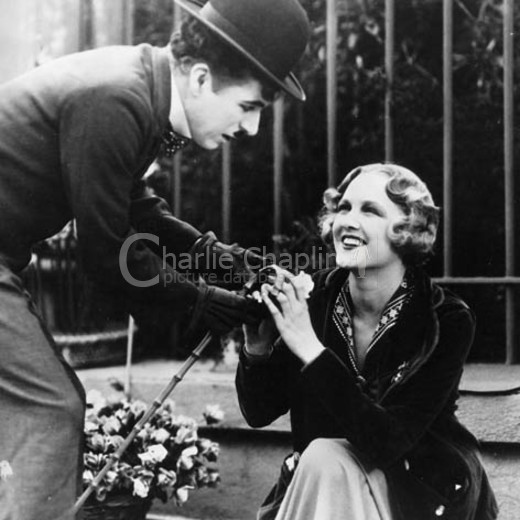
City Lights (1931, US, Charles Chaplin)

Silent comedy has always been a genre I know very little about - only seen the odd Chaplin film but never a Harold Lloyd or Buster Keaton. 'City Lights' was the first film Chaplin made during the sound era, and whilst he was under pressure to make 'City Lights' as a talkie, he had enough clout to film it as a silent though inventively compromised by inserting sounds, rather than speech. The "speech" in the film's opening scenes as a statue is being unveiled (which Chaplin's tramp is sleeping on) was recorded by Chaplin through a comb.

Described in the first titles as a "comedy romance in pantomime", the film is all this and more, both sentimental and funny. Chaplin's tramp, a clumsy and comical figure who constantly contrives to find himself in farcical circumstances meets a blind girl selling flowers in the street, and she mistakes him for a millionaire (she heard the door of an expensive door slam as he walked by), and that's pretty much the entire narrative. Saving an actual millionaire from drowning (which involves Chaplin almost drowning himself trying to save him), he gets access to that lifestyle, thus making his pursuit of the blind girl a bit more credible - he borrows the millionaires car and gives her a ride. Hilariously though, the millionaire only befriends Chaplin when drunk; when sober he remembers nothing.

Upon discovering that the girl's family is about to be evicted and also that she could have her sight restored with the right amount of money, Chaplin seems to address both these issues - the millionaire gives him the money but of course when he's sober forgets and assumes Chaplin has robbed him. Although the girl now anonymously has both her problems resolved, Chaplin went to jail. Upon release, he then seeks to find her in a conclusion that is remarkably sentimental by modern standards but is exceptionally moving with a killer final line that would have even the toughest and most cynical amongst us in bits. 'City Lights' is a staggering one man achievement, rightly considered one of the best comedies of all time because it balances the light hearted humour with emotional resonance. The pratfalls and humiliations Chaplin endures have a genuine romantic purpose to them, and the film isn't without it's darker moments, notably when Chaplin is arrested for theft and sent to jail. Plus there's also the issue whether the blind girl who now has her sight will fall in love with a tramp who's not what he appeared/claimed/was assumed to be. 'City Lights' is a comic masterpiece. Superb. 5/5

Matewan (1987, US, John Sayles)

John Sayles is a very unique film maker, operating both within and outside the Hollywood system. By working as a script doctor on large budget films such as 'The Spiderwick Chronicles' or sole script writer on many early Joe Dante films, he's been able to quietly pursue a directorial career with a distinctive left-wing agenda. 'Matewan' is one such film, a celebration of organised labour in the 1920s in the face of hostile big business. The miners of the small town of Matewan want to become unionised, which is strongly opposed by their employers. These employers use force, introduce black and Italian workers into the community to create tensions between these different ethnicities and nationalities - a divide and rule policy if you like. Naturally it works as the miners consider each other enemies rather than their exploitative management.

Then Joe (Chris Cooper) arrives in town, looking for work. Giving an impassioned speech at a union meeting, he explains how management divides their workers, creating conflict and tensions to ensure they don't organise and mobilise. Joe seeks to unite the different sets of workers, introducing the black and Italian workers into the union and the community. Naturally as his methods succeed, the employers exert more pressure - infiltrating the union, attempting to evict families, labelling Joe a Communist (which he accepts with pride) and using violence indiscriminately. Note how the church, an integral part of the community, seeks to uphold the status quo (to protect their own interests). A preacher played by Sayles proclaims socialism to be the new form of the Devil, though this contrasts with the preaching of the young miner Danny (a wonderful Will Oldham - now more widely known as the singer/songwriter Bonnie Prince Billy) which calls for unity and integration. Of course as the management and labour become more steadfast in their positions, a tragic and violent climax is inevitable.

Sayles' film is impassioned and optimistic, if completely biased in its tone and characterisation. That's fine; he has his agenda and it's a welcome contrast to the times during which he made the film - Reagan's America where organised labour and socialism were dirty words. I was constantly reminded of Paul Thomas Anderson's 'There Will Be Blood' when I saw 'Matewan' - I wonder if Anderson has ever cited it as an influence upon his own film. The dark, dirty and claustrophobic conditions in which coal was retrieved mirror those in which Daniel Day Lewis's character struck oil in the opening scenes of TWBB. There's the use of religion in both films with child preachers becoming increasingly influential over a community, and also how religion is entwined with the current consensus of opinion or indeed instigates it. These are intriguing parallels, and though I think Anderson's film is a much richer and ambitious piece of work; far more morally ambiguous as well, 'Matewan' makes a worthy accompanying piece and makes the most of its modest origins with stunning performances and cinematography (from an Oscar nominated Haskell Wexler) as well as Sayles tight script. 3.5/5

Thursday, 19 June 2008

Flanders (2006, Bruno Dumont, France)

Along with the Dardenne brothers, Bruno Dumont is the current darling of the Cannes crowd. L'Humanité (1999) took three prizes, although it missed out on the Golden Palm, and his latest, Flanders, also picked up the Grand Prize of the Jury. Much like the Dardennes, Dumont specialises in slow paced tales of trivial, mundane lives using non-professional actors. These are the kind of films likely to divide audiences and critics alike, and I have to admit myself that I wasn't totally convinced by the first Dumont film I've seen.

The main basis of the film concerns the barely-existant relationship between Demester (Samuel Boidin), a young farmhand, and Barbe (Adelaide Leroux), the local girl of loose morals, let's say. It's tentative, uncommunicative, and their sex that usually occurs in damp fields is silent, quick, unerotic and apparently devoid of any pleasure whatsoever. There's no affection or tenderness, and their mutual ambivalence about their relationship - characterised when Demester publicly denies that he and Barbe are involved, encourages her promiscuity with another local man, Blondel (Henri Cretel). The three then maintain a fairly uneasy relationship thereafter.

Everything changes when both Demester and Blondel are conscripted and sent to fight a war that isn't named, though is undoubtedly Iraq. What Dumont then pursues is a juxtaposition of images and mood between the hell of war and the relative idyll of their rural village. Dumont focuses on the psychological effects of war, especially in an environment where women are absent. Attacked by child snipers, they exact revenge, killing both. Civilian women are raped, and the entire regiment embark on a barbaric crusade of senseless violence against those they've been sent to fight, though mostly against the innocent. Not that the violence is quite so one-sided of course. Dumont shows exactly what revenge is extracted against them by their enemies - men are tied and dragged whilst naked or killed in the most brutal of fashions. All the while at home, Barbe continues to sleep around and has a complete mental breakdown. There's clearly supposed to be a correlation between these events, and when both are reunited, there is a sense of normality returning, though both have been scarred by events. Tellingly, Demester is now able to tell Barbe that he loves her.

I'm sure some might describe Dumont's work as Bressonian in its sparseness and naturalism, though I don't think it's comparable on any level of quality. Bresson shows humanity at work and that there is hope. Dumont shows no hope and seems intent on giving his audience a complete downbeat experience. 'Flanders' wants to be insightful and shows that indeed "war is hell", but for what purpose? People in Dumont's universe are barren and without hope, and his dispassionate focus upon these lives of nothingness become tiring after too long and this film barely clocks in at 90 minutes. I'm not sure whether it wants to be a film about war or a film about rural hopelessness. Either way, I didn't find it overly convincing. 2.5/5

Wednesday, 11 June 2008

Reflections on Eisenstein

Last weekend, I watched three of Eisenstein's earliest and most well known films; 'Strike' (1924), 'The Battleship Potemkin' (1925) and 'October' (1927). Commissioned as propaganda pieces, Eisenstein used these opportunities to reinvent the language of the infant cinema, and these three films remain amongst the most important and influential films of all time. I'm taking these films together rather than individually to avoid overlap and duplication of arguments and issues. All three films indicate examples of Eisenstein's talents and ideas about cinema, specifically the montage theory, and how these ideas came to predominate the three films on an increasing level, which resulted in 'October' for instance falling foul of the Communist Party as Eisenstein neglected pure propaganda for an exploration of cinematic techniques.

'Strike' was Eisenstein's first proper feature and meets the criteria of Communist propaganda more so than any of the following two features. It's narrative is that of a struggle at a factory between workers and management. Both classes are one dimensional as you would expect - the management are upper class exploiters and the workers are downtrodden and honest, forced to strike because they have no other options, because their exploitation has reached crisis point. Inspired by the suicide of a colleague who was falsely accused of theft, the workers communally agree to demands for fair treatment, which are dismissed out of hand by the management, represented by a scene in a gentlemen's club, where they arrogantly smoke cigars whilst dressed impeccably. The workers strike peacefully, but the police are typically heavy handed with their response. To catch the ring leaders, the police increase their brutality - in one devastating scene, a baby is thrown from an apartment, which then cuts to the laughter of the management. In one scene that metaphorically summarises this brutality, Eisenstein cuts between the slaughter of cattle and the dead bodies of dozens of workers, which is more powerful (especially considering the audience it was intended to reach) by relying on metaphor rather than showing the actual massacre.

Even at the point, it was possible to see Eisenstein's ambitions as a film maker, using visual techniques to propel a narrative. During the initial unrest at the factory, he shows workers having a conversation in the reflection of a puddle, possibly to indicate that all is not right. Animal metaphors are not just used at the film's climax; there is an ominous scene showing two cats hanging. Eisenstein was developing his montage theory when making 'Strike' - using a linkage of related images to carry the narrative forward but also to manipulate the response of the audience. See how he usually contrasts the distress of the workers with the arrogance of the management. It's not subtle but then it wasn't supposed to be. Only after the success of 'Strike' was Eisenstein able to follow his creative ambitions more.

'The Battleship Potemkin' remains Eisenstein's best known film and the film that most remains in the collective consciousness. It matters not whether it's been widely seen or not because the most famous sequence, the massacre on the Odessa steps, has been borrowed in a number of films, notably Brian de Palma's 'The Untouchables'. Like 'Strike', it's another twist on the class struggle between workers and management; this time set on the eponymous ship of the title. The regular sailors react against poor conditions, notably their diet of rotten meat, which they claim isn't even fit for dogs. Eisenstein then cuts to an extreme close up (seen through the glasses of the ship's doctor) of the meat, which is infested with maggots - though the doctor dismisses the sailor's complaints, suggesting washing the meat with brine and it'll be edible. The sailors mutiny against their poor treatment, summarised in one scene in which the 'leader' of the workers smashes a plate which features a design with the line from the Lord's Prayer "give us this day our daily bread" as if to signify the very basic diet these workers ought to expect.

Typically, this peaceful mutiny receives a heavy handed response from the ship's officials, who ask the petty officers to "string them up", showing the quite obvious class distinctions and animosities. At this point, there's a very startling shot, in which the ship's officials look up the mast and imagine two sailors hanging from there for a brief second. It's an impeccably handled insight into the mindset of the officials, which shows far more than if Eisenstein just showed what happened and ended the scene with their request to the petty officers. The officials then want the mutinous soldiers shot, which results in a scuffle in which Vaklunchuk, the "leader" of the sailors is killed. His death is avenged by the workers seizing control of the ship, with a symbolic shift of power (not just for the ship, but for the future?) with the white Tsarist flag being replaced with a red Communist flag. The locals of Odessa who join in with the public mourning, completely sympathising with the sailor, and uniting in a revolutionary cause. Does this indicate that revolution is incendiary; that it's spreading and can't be tamed and can only be addressed with force? The famous Odessa Steps sequence shows that violence is the only way the bourgeoisie can try to stop revolution; that they have already lost the political argument, and this violence is especially brutal. The army shoot at will, regardless of at whom. A child is shot and then crushed by people trying to escape from the army - almost making him a symbol of Tsarist oppression. Even those locals trying to stop the violence are shot. And then there's the famous pram sequence that was used to great effect in de Palma's 'The Untouchables'.

Whilst 'The Battleship Potemkin' can be seen superficially as a revolutionary propaganda film, reinforcing to its audience that revolution against the oppressive Tsarist regime was necessary, Eisenstein was using the film as a base for his montage theory, just as he did on 'Strike' and would continue to do so in 'October'. The editing is deliberately used to invoke the audience's sympathy on the side of the rebellious sailors, contrasting their virtue with the bloodlust of their officers and the army. Whilst it remains impersonal, devoid of characterisation and relying on symbolic, one dimensional characters, perhaps that's the point - the workers are one being, so injecting a personal element to the film might be to its detriment, 'The Battleship Potemkin' meets the objective Eisenstein set the film - to act as both propaganda and art. The film emotively gets across its message and narrative and allowed Eisenstein to revise the language of cinema.

'October' was commissioned to commemorate the tenth anniversary of the Russian Revolution of October 1917. The experimental nature of the film, in which Eisenstein explored his theories of montage to an unprecedented level, led to disapproval from the authorities who expected a film that was pure propaganda. The abstract nature of the film made what narrative existed incohesive amd difficult to follow, which was clearly a problem since the film was devised to reiterate to its audience that the revolution was necessary and successful.

Eisenstein depicts a pre-revolution Russia which is characterised by snow, poverty and people starving. Quoting Lenin, one of the intertitles states "it's the same old story, hunger and war" (Russia was especially suffering from World War One at the time). Lenin's presence in the film was reportedly not as widespread as the authorities wanted, though when he is involved, he's shown to be a man of the people who can engage wide support, as well as a gifted and convincing orator who can win people around to his way of thinking. Whether he's shown as heroic or the great leader of the revolution is another question entirely though.

Whilst Tsarist Russia is shown for its worst features, the Kerensky-led government that ruled Russia after the decline of the Russian Empire and the abdication of Nicholas II is shown as being no better, achieving no peace, no bread and no land. It was just another corrupt bourgeois government that didn't have the people's interests at heart. These counter-revolutionary are bourgeois stereotypes, shown disposing of Communist pamphlets (including its newspaper, Pravda) into the river, to prevent the dispersion of revolutionary literature. Abstract images are used by Eisenstein to particularly depict Kerensky, with associations to Napoleon (short man syndrome?) and a large mechanical peacock, which might relate to vanity or cocksureness. A startling montage of images that seem unrelated but were used by Eisenstein to draw comparisons between them (known as intellectual montage) feature to describe "God and country". The Christian God is associated with deities of other religions, such as Buddhism, Hinduism and Paganism, whilst 'country' is linked to military regalia and medals. The effect is achieved by the rapid cutting between these images and seems to undermine the entire principle of "God and country" where religion and patriotism were used to keep the masses down and prevent them from contemplating revolution.

Working on a larger scope and budget than ever before, Eisenstein was able to recreate the storming of the Winter Palace. This was apparently achieved more easily than the film suggests but for dramatic purposes, it's shown as a victory against the odds with the use of 11,000 extras. Whether it lacks historical accuracy or not is hardly the point as the film was a myth-making exercise designed to serve as propaganda. Interestingly, the film concludes with Lenin's proclamations and decrees on land and peace rather than showing the success of the revolution and its aftermath. Whether this is deliberately ambiguous or not, I'm not sure, but Eisenstein doesn't reflect on post-revolutionary Russia despite offering hope for the future.

The three films in question show a natural development by Eisenstein in revise the visual and technical language of cinema. Where 'Strike' was simple propaganda with hints at montage theory, 'October' almost abandons conventional narrative in favour of full-on experimentalism. In that respect then, 'The Battleship Potemkin' probably acts as the best balance between Eisenstein's twin instincts between narrative and innovation. It's easy to take Eisenstein for granted since his techniques have now become part of mainstream film making, but watching these films and seeing his montage theory develop and reach full effect, it's impossible not to admire how he rapidly cuts between images to drive the narrative. I've still yet to see the likes of 'Alexander Nevsky' and his two films of Ivan The Terrible. He made these films whilst somewhat compromised by the demands of the authorities who had grown to distrust his methods, but these films are still feted by critics nevertheless.

'Strike': 4/5
'The Battleship Potemkin': 4.5/5
'October': 3.5/5
Sunday, 8 June 2008

Letter From An Unknown Woman (1948, Max Ophuls, USA)

Max Ophuls' brief sojourn into Hollywood film making provided three undeniably terrific films. As well as 'Letter From An Unknown Woman', 'Caught', in which a woman marries a millionaire who reveals himself to be sadistic and controlling and 'The Reckless Moment', in which a mother tries to protect her daughter but becomes vulnerable to two blackmailers. Both films examined and scrutinised American values, but from an outsider's perspective for Ophuls was German, much like his contemporaries such as Sirk and Wilder who used melodrama and noir respectively for the same purposes. Both films were preceded by 'Letter From An Unknown Woman', whose source novel had been filmed before, but this remains the definitive and best known cinematic version. A superior melodrama, it's up there with the likes of 'Mildred Pierce' if we're looking at the better "women's pictures" of the time.

Set in Vienna at the turn of the twentieth century, it's the tale of a love affair that has existed over decades and ultimately ruined the lives of both participants; Stefan (Louis Jourdan), a gifted concert pianist and Lisa (Joan Fontaine), who loved him from afar and eventually has two ill-fated romantic dalliances with him. Ophuls begins with a glorious opening scene, one of the finest I recall, as Stefan receives a letter that stops him in his tracks - "By the time you read this, I may be dead". Until now Stefan has been a carefree playboy who thought nothing of moving from woman to woman. Now he has to face up to the responsibility of his actions. How Stefan got to this point is now revealed to us through flashbacks. He moved into Lisa's apartment block when she was a teenager and she developed an unrequited crush on him that unfortunately for them both never ceased, even after she left Vienna for Linz.

Over the next two decades or so, they meet now and again as she pursues Stefan and her dream of them having a life together. He never recognises her, she does of course. His intentions every time seem honourable enough - it's not as if he treats her as a one night stand, but we realise that Stefan is incapable of settling down with any one woman. His and Lisa's motivations are always completely different, and whilst their fates are inextricably linked forever, they can never have what either of them want. He says to her during their first affair; "promise me you won't vanish", to which she responds "I won't be the one who vanishes". It's as if she knows what his behaviour is like and how he treats women and that his promises are hollow, but this doesn't dissuade her at all. Her attraction and feelings overwhelm any common sense.

Lisa fell pregnant after their first fling, and she had since managed to achieve respectability by marrying a man with wealth and status, yet she jeapordises this by conducting another affair with him. The consequences of this were not only her husband's rejection but also her son's death as he contracted typhus when she was with Stefan and he did not reach the doctors in time. This might not directly be a moral judgement on her behaviour and rejection of respectability, but it's interesting how one's sympathies don't directly lie with Lisa and make us totally condemn the irresponsible Stefan. In many ways, they are equally weak-willed and motivated by hopeless dreams. However, their mutual attraction proves ultimately fatal and the final irony is the fact that Stefan's mute servant was aware all along that the girl who Stefan conducted two brief affairs with were in fact the same woman.

Ophuls would further develop his interest in romances determined by fate in 'La Ronde' and 'Madame de...'. His two following Hollywood films both featured scenarios in which love could be poisonous and that self-sacrifice and self-destruction were potential consequences of this. 'Letter From An Unknown Woman' probably remains the most enduring and impressive of the three films Hollywood films mentioned, certainly one of the defining melodramas of the age, with two excellent central performances and assured direction from Ophuls. 4.5/5

Monday, 26 May 2008

Le Mépris (1963, France/Italy, Jean-Luc Godard)

Godard's sixth feature was very much a departure for him. He previously made low budget films on the run. With international producers Joseph Levine and Carlo Ponti on board, Godard was able to utilise much larger budgets than he was used to in order to create a defining film about cinema, but so much more. As is always the case with Godard, there is far more going on than meets the eye. On one level, it's a film about the balance between art and commerce, whilst on another level, it's a film about a marriage breaking down. It might ultimately be read as Godard's own marriage breaking down or perhaps a film that very much is about itself - where the difficulties depicted onscreen reflected very much the difficulties that the film ran into whilst in production.

The opening scene of 'Le Mépris' reflects the arguments Godard had with his producers. Having finally cast Brigitte Bardot in one of the leads, the director and producers had different ideas about how she should be used. Ponti and Levine insisted on featuring Bardot nude - a demand Godard finally acceded to, but what he actually gave them was a distinctly unerotic image of a nude Bardot. Lying on the bed front down, Camille asks her husband Paul (Michel Piccoli) about her body; what he likes about it and so on. So nudity is discussed rather than shown, and what's more, it's a scene more about insecurity rather than a celebration of Bardot's figure. The scene completely subverts her public persona as the sex kitten of 'And God Created Woman' and other films. So the arguments within 'Le Mépris' between the producer Prokosch (Jack Palance) and Fritz Lang (himself) might reflect those between the producers and Godard himself. When Prokosch tells Lang "you've cheated me", should we interpret this as the general feeling about the actual film itself?

The narrative mainly focuses on an adaptation of Homer's 'Odyssey' at the Cinecitta studios in Rome, with Lang as the film's director who wants to make a faithful version of the poem, and Prokosch a crass American producer who wants more semi-nude mermaids to make the film more commercially appealing. Prokosch hires Paul, a playwright who worked on such terrific films as 'Toto versus Hercules' (which refers to Levine's producing past), to rework the script to his liking. Whilst deliberating over whether to accept the commission, Paul finds himself increasingly estranged from Camille, who has caught the eye of Prokosch and who makes his intentions pretty clear. It's a marital breakdown that is never really explained. Their arguments are evasive, and whilst it's hinted that Paul has been violent in the past, this never seems the likely explanation. Perhaps it's Paul's lack of integrity - the way in which he compromised his principles and the way he complies with Prokosch's wishes to see Camille which more or less encourages her infidelity.

This love triangle echoes that of the film they are making, with Paul as Odysseus, Camille as Penelope and Prokosch as Posideon. During moments of estrangement or argument between the couple, there are cuts to the statues of the Roman Gods, which reiterates this idea. Another interpretation is that of Paul as Godard and Camille as Anna Karina, which is emphasised by the instances of Camille wearing a black wig like Karina. The richness of Godard's films is that they're seldom as simple as they appear, offering a multitude of insights or understandings. The cinematic references also underpin the themes, with the likes of 'Voyage in Italy' also focusing on a marital breakdown. Filmed in Technicolour by Raoul Coutard and featuring a breathtaking score by George Delerue, two of Godard's most able collaborators across his career, 'Le Mépris' is one of Godard's finest; a masterpiece for certain, with only 'Pierrot Le Fou' matching it, in my opinion. 5/5

Veronika Voss (1982, West Germany, Rainer Werner Fassbinder)

"I have nothing to give you but my dream".

'Veronika Voss' was Fassbinder's penultimate film and concluded the loose BRD trilogy that also included 'The Marriage of Maria von Braun' and 'Lola'. These films examined the German economic miracle and political recovery during the 1950s under the Adenauer government. Fassbinder suggested that this rehabilitation and success was achieved due to corruption and compromise, as well as the cultural and economic imperialism of the United States. In each film, the main character is a woman who either succeeds or falls during the era. Whereas Maria von Braun and Lola were upwardly mobile women who sought a better life for themselves during these boom years, Veronika Voss is a woman whose successes were during the Nazi era and she finds herself unable to adjust to the new West Germany - she's a victim of the country's recovery.

'Veronika Voss' starts with a remarkably prescient scene that predicts events to come. Veronika (Rosel Zech) watches a film from her UFA past; a silent melodrama about a woman addicted to morphine who becomes exploited by her doctor, literally signing her life over to her. This is intercut with scenes with Veronika's memories of making the film, complete with depictions of life behind the scenes. This was clearly an act, though Veronika's actual dependency on morphine is very much real. A jittery mess, she is rescued during a rainstorm by a journalist, Robert Krohn (Hilmar Thate). She has delusions about her own fame, whilst he doesn't recognise her. Smitten, he examines her past to discover what happened to the actress who was feted during the 30s but fell out of public view. It was rumoured that she was a lover of Goebbels and relied on the patronage of the Nazis. In post-war Germany, Veronika struggles to find roles. Fassbinder perhaps contrasts with the fact that public officials during the Nazi era were still accepted after the war and were responsible for Germany's recovery. Denazification was a policy that some fell foul of but some did not.

Krohn discovers Veronika's "illness" through observing her withdrawal symptoms. Her doctor, Katz (Annemarie Duringer) is a superficially kindly doctor with a veneer of respectability, although below the surface something much more sinister is taking place. Again, should we see this as an allegory of contemporary Germany? Katz regulates the morphine she provides to her clients, increasing their dependency and desperation for more drugs, allowing her to exploit the wealth of her clients, ultimately ready to allow them to overdose for their wealth. Krohn's attempts to rescue Veronika are at her expense however, reflecting Fassbinder's perception of empathy as essentially a self-serving act motivated by self-interest rather than the good of the other. Krohn's help puts Veronika in more danger and also results in the death of his girlfriend. Only when it's too late does he accept the futility of what he sought to achieve - that he was unable to help her or stop Katz's schemes, and returns to his sports journalist position rather than undermine Katz.

Many of Fassbinder's preceding films were influenced by Sirk's melodramas. 'Fear Eats The Soul' was a direct remake of 'All That Heaven Allows' and other Fassbinder works were influenced by Sirk's use of colour and expressionism. 'Veronika Voss' is very much inspired by one of Hollywood's most corrosive examinations of itself; Billy Wilder's 'Sunset Boulevard' as well as the real life story of UFA actress Sybille Schmitz, who also died of a drug overdose in 1955, which is pretty much when the film was set, given the reference to West Germany joining NATO. Like with Norma Desmond, Veronika makes an abortive comeback, which demonstrates how the art of film making has changed. The opening scene showed Veronika as a silent actress who could weep on cue, but now finds the multitasking of doing this and reciting lines a problem (though this is probably also due to her morphine addiction considering she "breaks down" on set). It's a sign of an inability to adjust, not just perhaps to making films but life itself. Veronika's not used to no longer being recognised or famous and she cannot accept obscurity.

With cinematographer Xavier Scwarzenberger, Fassbinder recreates the aesthetic of many of the UFA productions that Veronika Voss might have starred in, with crisp black and white cinematography and typical methods of cutting between scenes. The reflection upon the Nazi era is important because Fassbinder believed there were attempts towards a collective amnesia about the entire duration of the Third Reich; that it was better not being discussed. He thought that West Germany would only genuinely recover and deal with its past through discussion and reflection. 'Veronika Voss' doesn't just reflect the past though; it carefully considers West Germany's contemporary success, suggesting it wasn't as honestly achieved as many would like to think. 4.5/5