Tuesday, 26 February 2008

The Boss Of It All (2006, Denmark/Sweden/Iceland/Italy/France/Norway/Finland/Germany, Lars von Trier)

Lars von Trier, the enfant terrible of European cinema, a director who is loved and loathed in equal measure and wants nothing else other than to wrong foot audiences who attempt to second guess his intentions, has done exactly that with 'The Boss Of It All', a comedy about office and corporate politics. This is a typically smart move having spent the past decade making films about female suffering ('Breaking The Waves', 'Dancer in the Dark') and satirising American values ('Dogville', 'Manderlay').

An actor, Kristoffer (Jens Albinus) is hired to pretend to be the director of a Danish IT company that is to be sold to an Icelandic corporation. The real boss is apparently "inaccessible", so the success of this takeover rests in his hands. Kristoffer is a perfectionist who prepares with great care, even though he is told to stick to the script and keep it simple. His staff, a collection of eccentrics, initially doubt his credibility. They have never met their boss, but what they know of him, through their email "conversations" with him eventually land him in over his head. Kristoffer then has to maintain the facade as best he can whilst negotiating with the Icelandic buyers, as well as not revealing who the real "boss" is. This is naturally not as easy as he thinks.

von Trier always had a blackly comic streak - think of The Kingdom and The Idiots, but here the comedy is less cruel and more lightweight - Kristoffer's awkwardness at playing the role is in the current vogue of embarrassment as comedy, but it's never mean. Kristoffer's meetings with the "boss" take place in ridiculous places; a cinema, a garden centre and so on, and he finds himself unwittingly engaged to one member of staff, and then there's the cultural issues between Danes and Icelandics (Iceland had been ruled by Denmark for 400 years), as well as Kristoffer's preciousness as an actor.

von Trier has always been a director with a knack for using technical gimmicks, and this is no different. Here, he used technology named Automavision, in which shots are framed by the director but then computers choose when to tilt, pan or zoom, which dispenses with the cameraman altogether. Certain framings and cuts do not conventionally work as a result. It's an interesting method of filming.

For a film with such a short running time, the film's climax seems a bit too drawn out, which gives the impression that the central conceit of the film is perhaps a bit flimsy and had to be fleshed out to make it feature length. Regardless of this, 'The Boss Of It All' is very funny, and though it makes a few general satirical points, it never feels as if von Trier is being heavy handed or weighed down by them. A diverting interlude before the third instalment of the Land of Opportunities Trilogy ('Wasington' being the third part). 3.5/5

Monday, 25 February 2008

My Blueberry Nights (2007, Hong Kong/China/France, Wong Kar-Wai)

The first English language film from the great Hong Kong director is an exceptionally frustrating experience. It would be natural to have reservations upon hearing of this project being produced, but despite all that could go wrong, there was the hope that Wong Kar-Wai would still deliver the goods. Alas, it's pretty disastrous, and deserves the critical kicking it took upon its UK release. Don't be fooled by its pretty reasonable average score on IMDB which highly inflates the quality of this film.

As you would expect from a Wong Kar-Wai film, it looks gorgeous. Darius Khondji, the Iranian born cinematographer who provided 'Seven' and the early Jean Pierre-Jeunet films ('Delicatessen', 'City of Lost Children') with their distinctive look, proves an able substitute for Wong's usual collaborator Christopher Doyle. He particular excels at the night scenes, where garish neon lights prevail. But we knew what to expect aesthetically. Few contemporary film makers can match Wong Kar-Wai in this respect, so there's no real surprise here. And that in all honesty amounts to any positive discussion of 'My Blueberry Nights' because practically everything else is rather substandard.

Watching the film, you get the sense in many ways that Wong Kar-Wai is producing a contemporary American spin on one of his masterpieces, 'Chungking Express' (1994). He uses the same visual trick that was prevalent in that film, which is very out of focus and rapid camerawork in faster than natural motion, as if the characters are in a sense of change or soul searching. Yes, it looks neat for the first time, and maybe that's part of the problem. Those not familiar might be rather impressed, but those familiar with Wong's work might feel as if they have seen it all before. 'My Blueberry Nights' also features loosely connected tales, which are in this case experienced by the same one character, Elizabeth (Norah Jones - surprisingly OK), who embarks on a journey of self-discovery after discovering her boyfriend has cheated on her.

She first gets talking to Jeremy (Jude Law - terrible), a café owner from Manchester, who is also heartbroken, and it's all quite cute; you know full well they are meant for each other by the way they have conversations that are composed of pretty ludicrous metaphors (nobody eating blueberry pie to denote loneliness perhaps?). Law's accent is shocking, and sets the tone for a film featuring several poor efforts in that sense. And why is he even from Manchester? He mentions this once and never again. He doesn't even need to be British - this makes absolutely no difference to the film whatsoever. Anyway, Elizabeth leaves for Memphis, works in a diner by day and bar by night, observing the destructive relationship between alcoholic cop Arnie (David Strathairn - reasonable) and Sue Lynn (Rachel Weisz - accent a slight improvement on Law's perhaps), which all ends tragically. Then reaching Las Vegas, she hooks up with a gambler, Leslie (Natalie Portman - similarly poor like Weisz) who has an estranged relationship with her father. And on the way, she learns lessons about life, love and so on before you can reasonably write the ending for yourself.

Early Wong Kar-Wai films like 'Chungking Express' and 'Fallen Angels' featured a sense of triviality that was easy to admire; much like the throwaway and playful centres of early Godard films. If Wong is trying to repeat this formula for this film, it really doesn't work. These episodes are so trivial, so uninvolving, it's hard to care. Does the marital breakdown of Arnie and Sue Lynn feel genuinely affecting? What about Leslie's reaction to news her father is dying? Not really. It's difficult to invest anything emotionally in these characters; probably because they're talking in such cliché-ridden nonsense for the entire film. I'm not sure whether this film is more scripted than other Wong efforts. I assume the fact he has an established co-writer, then perhaps, but the actors are not being given much to work with at all.

'My Blueberry Nights' doesn't know what it wants to be. An art film? A mainstream romantic comedy/drama? It strives to be both and succeeds as neither. So many of the aspects of a great Wong Kar Wai film are here in ultra-diluted form, and that is what disappoints. This could, and perhaps should have been a very good film. Unfortunately it isn't, and I'm afraid it's necessary to be brutal because it's the work of a great film maker, not some hack for hire. I appreciate that Wong had probably gone as far as he could in his home land, and that Hollywood will offer a chance to work with bigger budgets and different actors. His next film appears to be a remake of sorts of my favourite Welles film 'The Lady of Shanghai'. It has to be an improvement on this mess. 2/5

Sunday, 24 February 2008

The Ascent (1976, Soviet Union, Larisa Shepitko)

The Ascent is yet to be released in DVD format, and even obtaining a VHS copy is near impossible. A few years ago, I was fortunate enough to do so, but obviously had to pay quite a lot to do so. Regrettably, this means that very few people will have had the opportunity to see this film - it has marginally over 200 votes on IMDB. I can only hope that it is not long before it emerges on DVD, but even that might be complicated by who holds the rights and so on.

Whilst there are undoubtedly a number of Soviet films that approach World War Two in a typically one handed way, offering no more than simple propaganda, it is telling that the most famous Soviet films in the West are more sophisticated than this, and I'm thinking of Ivan's Childhood, Come and See, The Cranes Are Flying and so on. What these films have in common is a lack of glorifying the war effort, a recognition that heroism didn't come naturally, that some collaborated with the Nazis and so on, and The Ascent is no different to these aforementioned films.

Two soldiers, Sotnikov (Boris Plotnikov) and Rybak (Vladmir Gostyukhin) become stranded from their group (which is shown as being under-prepared and starving). Searching for shelter and food, they rearch a farm where they discover that the elder has collaborated with the Nazis. They condemn him for dishonouring their son, who is fighting, but his wife pleads that they did not do so willingly; that they were forced to. On the run, they then hide in a village which is also occupied by the Nazis. When discovered, the family they were hiding with, are also arrested.

Shepitko then focuses on the interrogation of the two men, who show distinctly different personality traits; Sotnikov is unwilling to talk and betray others, but Rybak is more weak-willed and talks more easily. The Christian imagery that had infused the film to this point becomes far more obvious now, with the soldiers representing Christ and Judas respectively; with Sotnikov becoming a martyr and Rybak offering his services to the Nazis and betraying his own people. Rybak also is shown being directly responsible for Sotnikov's death, though much like Judas, he finds this difficult to live with.

The nearest comparison to The Ascent is possibly Come and See, directed by Shepitko's husband, Elim Klimov. Both show not only the horror of war but also the level of collaboration of ordinary Soviet citizens with the Nazis. Both films are set in Belarus, which was occupied from 1941, and it is acknowledged that numerous native citizens were involved in massacres of towns and villages. The Ascent does not show all collaborators are treacherous or evil - the elder from the farm is the complete opposite of Portnov, the interrogator.

This was unfortunately the last film Shepitko made; she died in a car accident shortly after. The Ascent is a phenomenal war film - the black and white photography is superb, and as much of the film is set against a backdrop of snow, it almost looks like a blank canvass. Much like what the characters endure, the film takes a physical and emotional toll. Not a simple film to watch by any means but infinitely rewarding. 4.5/5

Thursday, 21 February 2008

Rouge (1987, Hong Kong, Stanley Kwan)

Hong Kong melodrama from 1987 directed by Stanley Kwan, who would receive international acclaim with his following feature 'Actress'. This was based on the life of Ruan Lingyu, the Chinese Garbo, who was most famous for Goddess (an exceptional film from the 1930s), and her life story shares so many aspects of Rouge - the 1930s, suicide, social pressure, forbidden romances, so it's almost as if in many ways that Rouge is a training ground for what is Kwan's most acclaimed and famous film.

Rouge has to be judged on its own merits though. It reminds me of Chen Kaige's 'Temptress Moon' in many respects, which also starred Leslie Cheung. Both are incredibly self-aware melodramas. This angle is deliberately played up and exploited - maybe because in the case of Rouge, the heroine belongs in the 1930s, the peak period for Chinese melodramas, which also throws her into a bit of a "fish out of water" situation in late 1980s Hong Kong.

Fleur, a courtesan (perfectly played by Anita Mui) and Chan Chen-Pang (Leslie Cheung), heir to a wealthy family fall in love despite the disapproval of his family, who have decided that he should marry his cousin for the benefit of his family's name and future. Such is their love for each other that they agree on a suicide pact, though it doesn't quite go to plan. Fleur, who died, searches for her beloved in a modern Hong Kong some fifty years after her death.

Whilst Fleur searchs, she engages the help and sympathy of a two journalists, Yuen (Alex Man) and Ah Chor (Emily Chu), a couple who are going through the motions and seem not too serious. Fleur's story makes them re-evaluate their own relationship, perhaps envying Fleur's passion, but also demonstrates how love has changed throughout the ages - they admire the sacrifices Fleur made and the lengths she went to in order to be with the one she loved. They concede they aren't that romantic.

With the film's self-awareness goes a wicked sense of humour too - see the scenes where Ah Chor, who thinks Yuen has brought a woman (Fleur) home, doesn't believe she is a ghost and then finds out comically. Add much technical prowess; the 360 degree turn of the camera as Fleur and Chen's eyes meet for the first time at the brothel she works at, the way the camera glides as Yuen notices Fleur appearing and vanishing when she first visits him at the newspaper office asking to place an ad for a missing person. Fleur might be a ghost but she is shown as a real person; there's no effects, she has emotions, thoughts, a purpose. It's a superbly fleshed out central character for what is a stunning film both visually and emotionally. 4.5/5

Monday, 18 February 2008

When Father Was Away On Business (1985, Yugoslavia, Emir Kusturica)

Emir Kusturica belongs in the select group of film makers who have won the Palme D'Or twice (for both this film and 1995's Underground), a feat which only the likes of Francis Ford Coppola and the Dardenne brothers have matched. I haven't seen any Kusturica films prior to this, but one gets the impression he's quite a frustrating film maker, albeit a remarkably creative one.

'When Father Was Away On Business' is set in 1948 just after the Tito-Stalin split which arose from Yugoslavia's supposed disloyalty towards the Soviet Union and the clash of personalities between the two leaders.Mesa, a womaniser, drunk, but also husband and father is arrested for pro-Soviet sympathies after a casual remark about an anti-Soviet cartoon. His brother in law, who is relatively disapproving and hostile towards Mesa, works for the police and is involved in his arrest.Whilst Mesa is in labour camps for the next two years, life goes on, and Sena struggles to raise her family, whilst also maintaining the lie about what has happened to Mesa - she tells her children that he is away on business.

The narrative is told mainly from the perspective of Malik, one of Mesa and Sena's children, who observes the world of adults from an innocent and naive angle, unaware of the implications of events and what he sees. Malik, an overweight boy has his own problems to deal with growing up, such as sleepwalking and falling in love, which contrast with the dangerous games that adults play.One artistic device Kusturica employs is using commentary of football matches involving the Yugoslavian team to drown out conversations or action made during moments of crisis involving the adults, as if from the children's perspective football is more important or more affecting to them than what is going on around them. Also, Kusturica shows a communist Yugoslavia which is united and comprises all ethnic and racial backgrounds, which contrasts with the explosion of ethnic and racial tension which would explode just a matter of years after this film.

'When Father Was Away on Business' combines whimsical humour with serious drama, though overruns a little and didn't always engage with me. Still, it's a pretty remarkable achievement as it was made in a country that had no cinema history to speak of. Whilst the rest of Eastern Europe was fairly productive cinematically throughout the communist era, Kusturica was the sole Yugoslav director of any note, and this was the first film to attract any real attention in the West. 3.5/5

Sunday, 17 February 2008

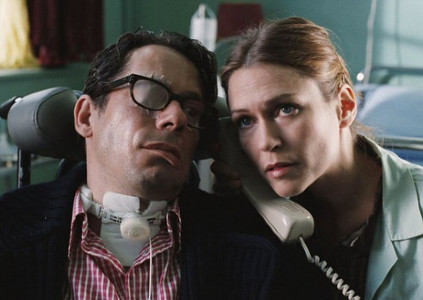
The Diving Bell and the Butterfly (2007, France/US, Julian Schnabel)

The remarkable story of Jean Dominique Bauby (Mathieu Almaric), who was able to dictate a biography comprised of his memories and imagination, through blinks after suffering a stroke, has been made into a remarkable film by Julian Schnabel, who won the best Director at Cannes for his efforts. Also nominated at this year's Academy Awards, I wouldn't be surprised at all if he won the award because on a technical level, this film is magnificent.

Mostly filmed from Bauby's point of view, with the camera literally feeling as if it is inside Bauby's eyes, observing the world as he wakes from his coma, Schnabel begins by filming totally out of focus to represent Bauby's disorientation after waking - the camerwork is fuzzy and blurred, superbly handled by Janusz Kaminski, who is best known as Steven Spielberg's DoP for the last decade or more.

Aided by his the mother of his children, his orthodontist and his physiotherapist (all of whom initially frustrate him because they're all incredibly beautiful), Bauby switches from self-pity and defeat to a resourceful and determined hero who refuses to let his condition overcome his life. This might sound like TV movie of the week material, but as those who have read the book know, it's incredibly affecting stuff.

It's to Schnabel and Ronald Harwood's credit that they don't alter Bauby's character to make him more sympathetic than he should be. We know he abandoned his family to embark on a series of affairs. He initially refuses help, wanting to die rather than remain alive for those who love him. But the book contract he had signed before his stroke provides him the opportunity to express himself through imagination and memory, the only working parts of his body besides his right eye. This gives him a zeal and reason to live. Despite the morose subject matter, this is one of the most life affirming films in recent memory. It's almost unbelievable to think this was almost made in Hollywood with Johnny Depp. You just can't picture it. 4/5

La Bete (1975, France, Walerian Borowczyk)

The notorious La Bete caused a sensation upon release and was swiftly banned in the UK on the grounds of depictions of bestiality. The origins of the film were in Borowczyk's previous film, Immoral Tales, which I have not seen, but appears to be an anthology of tales about sexuality through the ages, though not quite as effectively done as Pasolini and Fellini were accomplishing at the time when marrying the traditions of arthouse cinema and more adult content were in fashion. That said, if one reconsiders Cocteau's 'La Belle et la Bete' for a second, you might recall the subtle allusions to Belle's sexual attraction to the Beast - I recall one scene where she caresses a knife in a suggestive manner. Borowczyk is perhaps just making this more overt.

It had been filmed as one segment of this film but perhaps aware of the stir it might cause, Borowczyk made it into a full feature, framing a supposedly satirical narrative around the 18 minute short to put it into context. In short, the plot involves the arranged marriage between a British heiress and the son of a French aristocrat, who may have a dark secret that could put the impending marriage at risk. It really doesn't make a genius to work out what it might be.

Right, you know what you're in for immediately with the rather extended scene of two horses mating, watched with unnatural keenness by Mathurin, the son. Everyone in this house has some sort of perverted sexual preference, whether it's the visiting parish priest with the two altar boys at his side, or the daughter who's carrying on with the black servant (and then humps the bedknob when he is called into during the act). Some kinder critics have described this anti-clerical and anti-borgeois satirical elements as in the style of Bunuel, though this depends on whether you think Borowczyk cares enough about the narrative he has framed around the infamous dream sequence, and I am not totally sure he does.

The dream sequence (dreamed by Lucy during a moment of sexual delirium) clearly got the BBFC in a tizz, but watching it now, it's really hard to keep a straight face. You wonder whether this film generally is trying to be serious or comic. It really is difficult to tell. Anyway, the scenes of bestiality are pretty ludicrous - a man in a wolf suit, with a rather large fake phallus chases an aristocratic woman around, removing her clothes, before finally having his way with her. What might have been a problem was the fact she obviously starts to enjoy the attack and what's more turns the tables, becoming the more aggressive partner in this act. How anyone could find this offensive really is beyond me. I know it's the implications of these events, but they're filmed so ludicrously, you couldn't possibly take it seriously. And that's the film in a nutshell. Still, if you overlook the awful acting and dialogue, there's still plenty of interesting if half-baked ideas on show. Films of notorious reputation should often be seen out of experience, but if the BBFC really wanted to ruin or undermine this film, it would have been better off leaving it unbanned, where it clearly would have been forgotten and not had the reputation it enjoys now. 2.5/5