Monday, 22 October 2007

Once (2006, Ireland, John Carney)

How does a romantic comedy that cost approximately £70,000 to film make $10 million and counting at the US box office? Simple. Follow the conventions of the genre, but do in a way that feels original and fresh. John Carney, an ex-bassist in Irish band The Frames directs his former bandmate Glen Hansard and Czech newcomer Marketa Irglova in this Dublin-set tale of boy meets girl (Carney states that the setting of Dublin is that of around 15 years ago when it had more of a working class feel to it). The unnamed characters randomly meet one day when he is busking and she is working one of her numerous jobs that she has to undertake in order to support her family, who are recent immigrants. She too has musical talent, and impresses him with a recital of a piece by Mendelssohn, which leads him to ask her to add piano to one of his own songs "Falling Slowly".

Their musical collaboration mirrors their budding relationship, though they both have problems of the heart that get in the way. He's considering moving to England to win back his ex-girlfriend, whilst she has a husband back in the Czech Republic. When he asks whether she still loves him, she replies in unsubtitled Czech, though we instinctively know what she says. Still, Carney refuses to make the path of true love simple and doesn't rely on the kind of contrived slush that most films of the genre would fall back upon.

Much of Once's appeal depends on whether you love the music or not, which kind of falls into the kind of coffee table folk practiced by the likes of Damien Rice, though not quite as bland. It's not normally my thing, but works in context really well, but it might understandably be a hurdle for some. Still, the film was done wonders for the profile of The Frames, even drawing the attention of Bob Dylan who offered them a support slot on his latest tour. Some cynics see this as nothing more than a promo for the band. I don't know about that. There's certainly a sense of something about this film; maybe it's the fact that a no-budget film has succeeded in the US, maybe it's the fact that music is a core part of the film and not window dressing - that it actually drives the narrative, but moreover it works on an emotional level for me, which few, if any contemporary romantic comedies ever could.

Monday, 8 October 2007

Control (2007, UK/USA, Anton Corbijn)

As a Joy Division fan, I was looking forward to Control so much. It had received great reviews, it's based on a biography by Ian Curtis' wife, and is directed by Anton Corbijn, who was the official band photographer and an artist I greatly admire.....so why did I find Control so unengaging?

Not that there's anything obviously wrong with the film or anything. You couldn't fault the efforts of the acting personnel in any way at all; both Sam Riley and Samantha Morton as Ian and Deborah Curtis perform sterling work, and most of the supporting actors are more than adequate. Corbijn uses black and white to perfectly catch the period in which Joy Division emerged from - Macclesfield, a small town outside Manchester during the 70s, just prior to the explosion of punk.

Maybe the opening half an hour that concentrates of the teenage Curtis seems a little unnecessary beyond showing Ian meeting Deborah for the first time, and their teenage relationship that quickly became a marriage and family. Watching Corbijn longingly focus his camera on the semi-naked Curtis, listening to Bowie, Reed and Iggy Pop and reading Crash, The Naked Lunch and Howl (yeah, he's cool, we get it) just grates a bit after the first instance.

Curtis never appears to be too interested in keeping a balance between harmonious domesticity and his band (he's mean towards Deborah even before his lover Annik arrives on the scene, and he's nothing like a doting father on this evidence), so perhaps we should applaud Corbijn for not mythologising Curtis too much and presenting him as he really was. The steady rise of Joy Division around 1979-1980 coincided with Curtis developing epilepsy; the pressures of which eventually told as his condition was always going to affect the band (several gigs were abandoned during his horrifyingly recreated seizures) and his marriage. Falling in love with Annik, a glamorous Belgian wasn't able to make Curtis happy as he still felt bound to Deborah and was unable to make a final break with her. Eventually the mounting pressure told. Curtis delivers a soliloquoy admitting his weaknesses, that he's given all he can possibly give and yet people still ask him for more, which asks questions about the future of Joy Division had he lived - would he have still wanted the band to be successful and all the trappings that go with it. As we know, he didn't.

Corbijn films Curtis' decline as sympathetically as he possibly can without making him look too glamorous. We never really get to know too much about his relationship with Annik, which isn't surprising as the film is based on Deborah Curtis' book, and I'm not sure whether the mistress was involved in the production in any way. What was private between them presumably still remains so, so her character isn't fleshed out so much, and we never know whether they were happy, so maybe that's a valid shortcoming of the film - that you don't get the whole story, just what is known.

Control really succeeds in the recreation of Joy Division's music though. The actors playing Stephen Morris, Bernard Sumner and Peter Hook are all talented musicians in their own right, and with Sam Riley, they play Joy Division's music rather than rely on miming with backing tapes, and it works so much better for doing so. It evokes what it must have been like so much more, and also reminds you that live they sound so much louder and primal than they did on record, which was partly because of the excellent production job that Martin Hannett achieved on their records. It's then that the film comes alive. The fact that it doesn't always do so makes Control something of an uneven film. Maybe it's too reverential who knows; that the people involved want to do Ian justice so much that the film never feels alive.

Dead of Night (1945, UK, Alberto Cavalcanti et al)

Dead of Night is a superior horror film from Ealing Studios, best known for its whimsical comedies. Invited to a country house, an architect believes he recognises all of the other guests from a surreal and recurring dream. The other guests then all tell nightmarish tales they have experienced or heard (a racing driver who avoids death, a dead boy seen during a hide and seek game, a man who is possessed by the reflections he sees in a mirror, a jovial tale of golfers fighting over the same woman, and a ventriloquist and his dummy whose personas are inextricably linked).

Rather than using explicit shock tactics to frighten the audience, Dead of Night relies on the power of suggestion to create a genuinely disturbing work. It superbly combines five stories to create its climax, the most celebrated and best being the Haunted Mirror and the Ventriloquist's Dummy. These are psychological segments, showing mental breakdowns as played by increasingly unhinged protagonists. Both tales use themes of possession by supernatural forces, as if to speculate upon the frailty of personality. These are tales to make you think rather than blink, and because those who have these dreams believe them to be so real, it makes you consider the fine line between sanity and insanity, reality and illusion. When these tales interweave, they create a somewhat bizarre and head-spinning denouement, which involves a terrifying shot of the dummy moving off his chair and walking to the architect to strangle him (the dummy is incredibly frightening since you consider it was played by a very short man, so it does look lifelike). The end credits show the " dream" becoming real, with the architect receiving his invitation to the country house, and we know what we've seen will actually occur. Dead of Night is definitely one of the better psychological horrors, and a film the British Film Industry should be proud of, but alas, doesn't make any more.

The Hole (1998, Taiwan/France, Tsai Ming Liang)

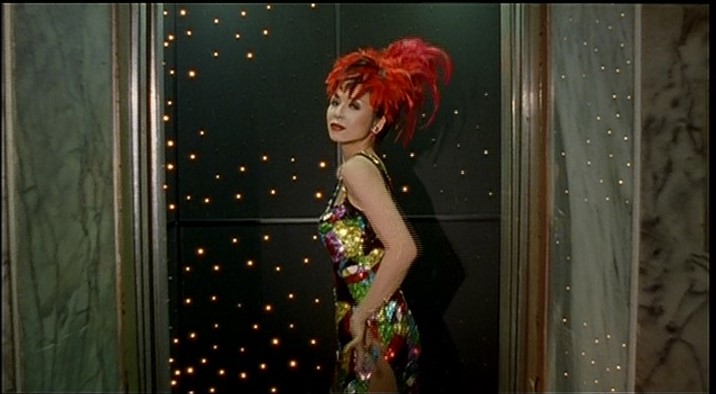
At the end of the millennium Taipei is overwhelmed by an epidemic that the government cannot contain, and the rain is torrential and endless. Whilst most people are evacuated, in an anonymous tower block two residents stay around. The potential for connection is both metaphorically and physically created by a plumber's poor workmanship which creates a hole in the floor/ceiling which separates their apartments. The unnamed male and female protagonists go on with their lives as best they can in a pretty unpopulated city where food and provisions are scarce, but they sometimes meet, which then turns 'The Hole' into a surreal musical. In glorious colour, Tsai Ming Liang portrays her state of mind through stunningly choreographed song and dance routines where the woman believes she is Grace Chang, a Taiwanese pop singer from the 1950s and 1960s, and croons her way through several cabaret style songs of love and longing, which is in stark contrast to the dire situation she finds herself currently in.

Back in reality though, the protagonists try to stick with their routines; hers involves the odd stockpiling of toilet roll and he sticks to voyeurism. The prevailing theme in Tsai Ming Liang's films is the need for connection and the inability for individuals to achieve it in the modern world (maybe he's the heir to Antonioni in that respect), and these individuals struggle with their need to make contact with each other, though the final scene finds the man and woman finally doing so, which begins one final musical fantasy. Tsai Ming Liang's film may be as much about Grace Chang as it is these individuals. He closes with a respectful acknowledgement towards her music and the joy it brought him, as much as it did for the female protagonist of The Hole.

Thursday, 4 October 2007

The Ear (1970, Czechoslovakia, Karel Kachyna)

Like most of the films that were made during the burst of film making creativity in the late 60s in the former Czechoslovakia, The Ear was banned - the authorities took a disliking to the open criticising of the methods employed by the secret police to spy on its own government officials.

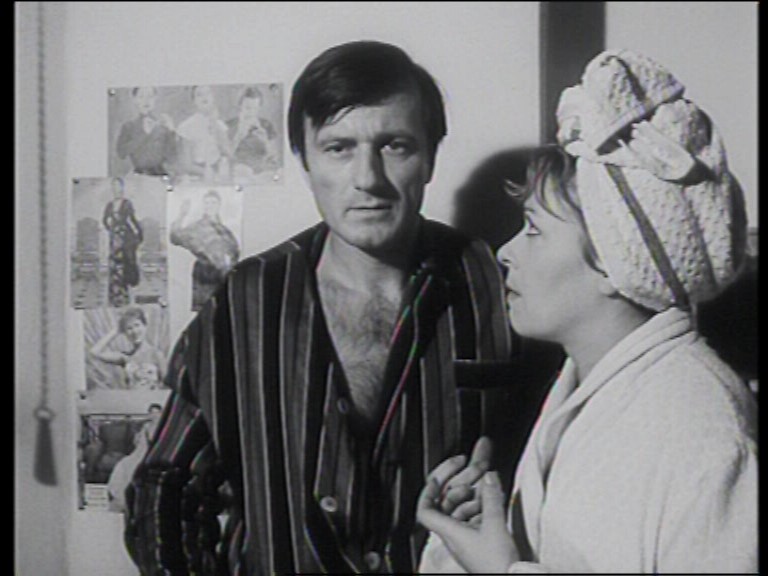
A middle aged couple, Ludvik (a high ranking bureaucrat) and his tipsy wife Anna return home from a party to find that she has lost her keys and that they are locked out. Ludvik breaks in to find that the keys are inside and the power and telephone is cut (yet the power at their neighbours is clearly on), whilst Anna rebukes him for his efforts as the gate was open. These small odd occurances combined begin to unsettle the couple and open existing wounds in their marriage (think Who's Afraid of Virginia Woolf? under a totalitarian regime perhaps).

Thinking over events at the party, Ludvik begins to wonder whether he is under surveillance by the state, like a recent colleague who has since been arrested. He disposes of anything incriminating (which blocks the toilet) and takes care with what he says, partially drowning his conversations with Anna with the radio, though she doesn't share Ludvik's suspicions until she seens men furtively wandering in the gardens.

When the power returns and a number of men appear at the gate, frantically ringing, both assume Ludvik is about to be taken away, though it emerges that these men are friends of his from the party. Anna's paranoia outstrips Ludvik's, who at least superficially seems calm and reassured, though this is probably a facade whilst he tries to figure out what's going on. By the morning however, all becomes clear of the purpose of these men. For the rest of the evening, Ludvik and Anna project their fears onto each other and become totally frank about their loathing for one another in order to hurt the other - Anna taunts Ludvik with her history of promiscuity, whilst he tells her he was only interested in her money. However, when they find bugging devices all over their home (planted by their guests), this almost solidifies their marriage as they have to work together to save themselves. In a blackly comic denouement, Ludvik is promoted to replace Kosara, his friend who was recently arrested, though the future is somewhat indeterminate.

Similar to The Party and the Guests in its commentary of the power of the state, The Ear is far more open and far less cryptic than the former. It demonstrates the personal effects of political actions and the impact that fear and paranoia, rather than overt action, has on a marriage. Not that we find either Ludvik or Anna that sympathetic - both are driven by self interest and opportunism, which is possibly the way to get ahead in a totalitarian society. It's perhaps fitting therefore that even after Ludvik's promotion, both remain cautious and concerned for the future, no doubt in light of what happened to the previous incumbent of that post. Where Ludvik and Anna go from the long night that has just passed, who knows?

Monday, 24 September 2007

The Eclipse (Italy/France, 1962), Michelangelo Antonioni and The Red Desert (Italy/France, 1964, Michelangelo Antonioni)


A double bill of early Antonioni films that focus on the alienation of modern industrial societies, both featuring the glamourous (and gorgeous) Monica Vitti. The Eclipse forms the third part of a trilogy with L'Avventura and La Notte, both of which I've yet to see, whilst The Red Desert seems to further develop the themes from these films, although Antonioni uses colour and sound more prominently to emphasis the alienation of his protagonists.

The Eclipse begins with an agonising and drawn out break up. It's several minutes before any meaningful dialogue; the silences speak more than the actual individuals involved ever could. Vittoria (as played by Vitti) is by her own admission "tired, depressed, disgusted and disorientated". When meeting her feckless mother who gambles daily at the stock exchange, she meets Piero, a stockbroker (played by Alain Delon), who pursues her, even though she rejects his advances. To Vittoria, love is a great effort. Piero on the other hand is ruthlessly materialistic and successful; witness the exceptional replication of the goings on at the Rome stock exchange where he thrives. He too is insensitive - when a drunk steals his car and drives it into the river, he is more concerned about the car than the fate of the dead man. He represents the vitality of capitalism; the source perhaps of contemporary human alienation, and her romantic and brooding personality so at odds with his dooms their future - she is unable to love or know him, so she chooses to be alone rather than marry him.

The Red Desert is thematically quite similar. Vitti is Giuliana, a wife recovering from a car accident, who finds no understanding from her husband and finds herself unsettled in her environment. Using colour for the first time, Antonioni is able to amplify this sense of alienation through the unique palette he employs (the reds in particular are very striking in colour), as well as the electronic soundtrack he uses, which is incredibly disorientating, thus reflecting Giuliana's state of mind. The bleak landscape of Ravenna (heavily industrialised and polluted) adds further emphasis to her sense of dislocation. Giuliana's husband's behaviour encourages her to consider an affair with an engineer played by Richard Harris, who seems more sympathetic to her neurotic condition than her husband.

The Red Desert to a degree concludes Antonioni's examination of alienation and loneliness in the modern world. Both films are emotionally devastating pieces of work, held together by the phenomenal performances given by Monica Vitti. Whereas The Red Desert is probably the more ambitious of these films, it does feel like the less involving, though maybe that's the point. Much time and patience has to be invested in these films in order to get the most out of them as events in them often appear pretty random, but all form part of a studied examination of the malaise of both characters that Vitti plays. Antonioni's films have tended to be pretty divisive critically, and these are no exceptions. They will baffle as much as they will entrance.

Friday, 21 September 2007

The Painted Veil (US, 2006, John Curran)

Adapting classic texts is always a tricky proposition and often a gamble. Just consider how The Bonfire of the Vanities and the numerous versions of The Great Gatsby turned out. Such is the weight of expectation, as well as the fact that film makers have to respect the original work, perhaps it's no wonder that it sometimes goes wrong. As the Maugham novel is one of my favourites, I felt a degree of concern at how the novel would be treated. John Curran and Ron Nyswaner, the screenwriter has remained pretty faithful to the novel, though I'm pretty of the opinion they overdeveloped the love that Kitty begins to feel for Walter after years of a loveless marriage (there was nothing like the later passion in the book). There's shifts in chronology too - the 'England' scenes are shown entirely in flashback and it feels like they're rushed through (even though this is a two hour film!). Because of this, the film loses some of its context.


Kitty's change from vain society girl to selfless and compassionate wife is plausible enough thanks to the Naomi Watts, who's easily gives the best performance here. I've reservations about whether Edward Norton was the best choice for the role of Walter. Can you really suspend disbelief enough to think he fits Walter's character. I also think he affects the English accent in the way many non-English actors do; very slow and deliberate speech, making sure every syllable is properly pronounced so that it sounds forced, but maybe it's a churlish point to make. Not to say Norton doesn't equip himself well, and it sounds as if he was passionate about the film being made, so kudos for this.


The film certainly looks great; the use of locations and cinematography are superb, though one wonders whether the film makers had seen how Chen Kaige and Zhang Yimou had managed to capture the Chinese landscapes on film previously to make them look exotic and dazzling. Whether one gets more from the film having read the novel, I don't know. Most of its audience probably won't have read it so will approach this film as a period romance of the classic kind (it's still superior to most contemporary middlebrow film making however), whereas those familiar with the novel will probably have to judge the film next to it. It's as good an adaptation as one might have hoped; obviously things have to be condensed and simplified in cinema. I'm not sure we get the overview of the Fane's marriage that the novel presents, nor the motivations behind Walter's suicidal decision to take himself and Kitty into the middle of a cholera epidemic in China, but I think the film makers did more than enough with the constraints they had (there was also the pressure of Chinese commercial investment in the film that led to some minor cuts).