Friday, 27 July 2007

When a Woman Ascends the Stairs (Japan, 1960, Mikio Naruse)

The BFI Southbank showed a retrospective of the shamefully overlooked Japanese director this July, of which this film was the focal point, and according to many, the high watermark of Naruse’s career. Most discussions about the early post-war Japanese cinema concentrate on the three directors known in the West; Kurosawa, Ozu and Mizoguchi. There is certainly no reason why on the basis of this masterpiece that Naruse should not be discussed in the same breath. Many of his other films which I’ve yet to see (‘Repast’, ‘Floating Clouds) are reportedly the equal of ‘When a Woman Ascends the Stairs’, yet very little of his output is available on DVD; just the three film box set at present, though perhaps this might change in the near future. Thematically, Naruse has much in common with Mizoguchi, concentrating on the position of women in Japanese society, their subjugation and mistreatment by men and his sympathy usually resides with those women on the margins of society, such as Mama San, the heroine of this film.

A hostess approaching her thirtieth birthday, an age where women in her profession are considered past their sell by date, Mama San yearns to own her own bar, yet she’d require the patronage of a wealthy backer, which would be unlikely without prostituting herself. Yet Mama San is a dignified woman, far more refined and virtuous than some of her fellow hostesses. She frequently mentions that women should not be loose and that they lose their charm if they fool around. Despite the nature of her profession, Mama San aims for respectability; she hates the ascent she makes from the respectable street level life to the more sordid world of her work. Mama San is caught in a vicious circle she can’t leave; a widow since her husband was run over, she supports her feckless family as well as her own son. An impossible set of pressures to balance, Mama San makes a number of poor decisions thereafter, though never once loses the sympathy of the director.

Aware of the need to find a rich husband, she agrees to marry Sakine, an amiable large man, who is more respectful towards Mama San than many of her clients, even though she does not love her. Her nephew needs an operation to walk, but her act of self-sacrifice comes to nothing when she discovers that Sakine has a wife and has little money. Shattered, she starts to drink herself to death and becomes everything she vowed not to become, allowing herself to be seduced by Fujisaki, a man who loves her, but cannot bring himself to break up his family to be with her. Mama San’s manager who also loves her, is aware of this and informs her that he is disappointed in her and lost all respect for her. Mama San refuses to marry him, thus leaving her in the same position that she began the film, only compromised in her morals and in fear of being ‘past it’.

Like Mizoguchi, Naruse was a master at examining the role and position of women in Japanese society, though his interest was in more contemporary settings and environments than Mizoguchi, who approached these themes from a more historical perspective. Always sympathetic to his females, he presents the men on whom they depend as fickle and weak, always ready to betray and sacrifice them. The man Mama San loves is unattainable, yet keeps her at sufficient distance to give her hope, and the man she agrees to marry isn’t what he appears to be at all. The dashing of these dreams sends her into a downward spiral she doesn’t recover from. The unglamorous world of these late night bars are seen as traps that these women cannot remove themselves from; the potential riches derived from them are enticing enough to make women consider compromising themselves, and those not willing to totally give themselves to them are in danger of falling apart. A tragic, heartbreaking tearjerker.

Tuesday, 3 July 2007

A Long Weekend in Pest and Buda (Hungary, 2003, Karoly Makk)

The collapse of Communism had a significant impact upon the fates of many of the gifted film makers from Eastern Europe. Some, like Kieslowski and Tarkovsky, had been courted by the West, and were able to adapt and make their films free from political influence and on their own terms. These directors had made films that had been international successes, but directors of more low key, but arguably equally impressive films, did not share the same benefits. Those who remained in their home countries were faced with national film industries with little concrete infrastructure. Films were now made according to commercial pressures, and many of these directors did not have a history of making commercially viable films. Karoly Makk is one such example, having worked on only a few projects since the 1990s, most notably ‘The Gambler’, a cross-national film, which I’ve not seen, but doesn’t appear to have anything like a good reputation.

Following this, Makk was able to make a sequel of sorts to his remarkable ‘Love’, made in 1971. The characters are now different; Luca has become Mari, and Janos has become Ivan, but the two actors more or less reprise their roles from ‘Love’. Flashbacks from ‘Love’ are used, and the husband was also arrested during the 1950s on political charges, so whilst it’s not a straight forward sequel so to speak, it’s not far off.

Mari and Ivan are no longer married, but they appear in each other’s lives once more when Ivan (now living in Lugano) receives a telephone call from Mari’s nurse, who explains to him that she is close to death and that if he is ever going to see her again, it has to be now. Ivan has a new life, a second wife, but returns to Hungary, where he has not been since fleeing after his release from prison many decades before. The Hungary of the 21st century is vastly different to the country he recalls. Having embraced the spirit of capitalism, Makk focuses on many of the negative side effects of this; homelessness, and crime for example, as well as the gaudy excesses.

Makk’s intentions are not to seek reconciliation between Mari and Ivan, whose marriage is well beyond them. However, when Ivan fled Hungary, Mari was pregnant. Mari had never told Ivan, and told her daughter (Anna) that her father was dead. Ivan now seeks to establish a relationship with his daughter, even at the risk of re-opening old wounds. Mari confesses to Ivan that she was partly responsible for his imprisonment, having reported on him for activities she assumed were harmless, but were significant.

Anna has her own issues though; an on-off relationship with a semi-legitimate businessman (another indication of the corrupt post-Communist world), so Ivan’s arrival only serves to complicate things further. Ivan shows her his place of birth and tells her of his childhood to connect with her, though this excursion has tragic consequences, when they both miss Mari’s death, which Anna blames him for. Rejected by her and with his ex-wife dead, Ivan returns to Lugano; his wife gone. The film closes with Anna calling her father; their relationship appears to be a permanent one, lasting beyond the death of the woman they had in common (similar to ‘Love’ in many ways).

Makk’s film would be a pretty successful venture in its own right, though it’s hard to be too objective watching it, as it’s going to naturally draw comparisons with ‘Love’, which I consider a masterpiece. The themes of ‘Love’ and the political conditions in which it was made and set aren’t so prevalent here. ‘A Long Weekend…’ is a film purely focused on reconnection between people, which is fine, but doesn’t have the same kind of depth its predecessor had. The comparison between Communist and post-Communist Hungary is interesting though; capitalism and materialism present their own problems, and Makk is by no means suggesting things have improved. It’s often said that film makers during Communism faced political censorship, and post-Communism, they face economic censorship. Films are not being made because of commercial interests rather than political interests, and one wonders whether Makk has revisited ‘Love’ because he considered there was unfinished business, or whether it was the only way he could make a film on his own terms. So whilst it’s intriguing in its own right, it’s probably not essential viewing without having seen ‘Love’.

Wednesday, 13 June 2007

The Red and the White (Hungary/USSR, 1967, Miklos Jancso)

Set during the Russian Civil War of 1918-1919, The Red and the White is a cool and dispassionate account of war devoid of heroism or appeal. The main focus is the role of Hungarian volunteers who enlisted to assist the Bolshevik Reds, who were fighting the White counter-revolutionaries. However, Jancso refrains from showing complete bias, portraying both sides as merciless and pitiless, and capable of committing atrocities against their fellow countrymen. Despite being commissioned to mark the fiftieth anniversary of the Russian Revolution, the film was subsequently banned; most likely because it didn’t tow the party line and remained distinctly impartial, and also because the 1956 Hungarian Revolution that was brutally repressed remained in the collective memory.

Many Hungarians joined the Russian cause because they thought that in the long run, it would benefit their own country, which faced an uncertain future when the Austro-Hungarian Empire was dismantled by the peace settlements of 1919, and Hungary became an individual, self-governing nation. The question of course is, did it? Since Jancso shows the Reds in a none too sympathetic light, perhaps not. Many Russians were less than keen on Hungarian involvement; some Hungarians are told that they don’t want them fighting their war. In many ways, The Red and the White summarises and reinforces the often fraught relationship the two countries have endured over much of the twentieth century.

One could argue that Jancso films with a policy of detachment. The Reds and the Whites are never named and are often indistinguishable, there is little in the way of characterisation, and his main cinematographic preference is for long takes with very little camera movement, often from distance. It’s as if the director doesn’t want to get too close to his subjects or attempt to analyse or empathise with them. He prefers to depict events as they occur and have little more input beyond this. This approach allows him to be impartial and not sensationalise or over dramatise the numerous shocking acts of violence he films, such as massacres of entire towns, allowing enemies a few seconds head start to run before being picked off, and coldly shooting enemies right between the eyes indiscriminately. Despite much of this violence being committed by the Whites, Jancso affords some of the counter-revolutionaries a conscience and a degree of moral integrity. When one White soldier attempts to rape a woman in a small town, his officer orders him to be executed for his dishonour. This captures the peculiar mindset of men at war; that when faced with your enemies, anything goes. Yet those who are innocent and uninvolved should be treated with respect and dignity. It’s strange just to be able to turn on and off like that.

Where there is anything like a narrative, I suppose it exists as much as concentrating on a few Hungarian Reds trying to avoid the Whites and escape capture. The unlucky escapees commit suicide before being captured, whilst the fortunate either ambush the Whites, hide in lakes whilst they pass, or pretend to be wounded Whites at a nearby infirmary. The nurses explain that there are no “Reds or Whites here, only patients”, reinforcing that these are men with much in common, separated by ideology (though interestingly we never hear any indications of the ideologies of these forces or why they’re fighting). The Whites arrive and ask for the Reds and the Whites to be separated, though this coincides with a major fight back by the Reds, culminating in a glorious and sweeping shot from distance of the two armies marching towards each other (which cannot be told apart) at approximately 1 hour and 20 minutes into the film. This resolution is open ended, with no judgements of any kind, or any indication of how events might pan out. Jancso sees the whole futility of this exercise and closes with a march towards death, with the forces fighting for no other reason than to fight.

Saturday, 9 June 2007

Szerelem (Hungary, 1971, Karoly Makk)

Karoly Makk is considered one of the best post-war Hungarian directors, and is certainly one of the best cinematic commentators of the Communist experience in Eastern Europe. ‘Szerelem’ (translated as ‘Love’) is his best received film, and finally gets a Western release thanks to the sterling work of Second Run, who are steadily carving out a niche for themselves as distributors of great, unknown films from largely ignored national cinemas. Based on two short stories written by Tibor Dery, Makk’s film nominally focuses on the love a wife (Luca) and a mother have for a man (Janos) whom we never see until the final quarter of the film, and the relationship between the two women.

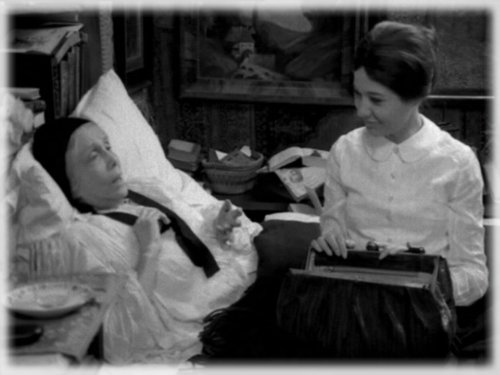
‘Szerelem’ is set in 1953, when Hungary was under the totalitarian rule of Mátyás Rákosi during which thousands of real and imagined foes were killed or arrested. Janos has been arrested on an unknown, but presumed fictitious charge, and is serving a nine year sentence. Luca is not permitted to see her husband and knows not whether he is alive, let alone in good physical health. Janos’ mother is looked after by Luca and a housekeeper. A seriously ill, bed-ridden woman, she does not know what has happened to her son. Since she does not have long to live, and that the shock of Janos’ arrest might kill her, Luca constructs a web of deceit, writing letters supposedly from Janos that tell of his great success as a film director in the United States. These are very elaborate letters, written in great detail, that even the housekeeper claims are beyond the realm of probability. So why doesn’t Janos’ mother suspect that not all is as it seems to be? Luca tells the housekeeper that she is ‘deaf and blind’ when it comes to Janos. Such is her love for her son that she will believe any news of his supposed success.

However, there is one idea that she wants to believe what Luca’s letters present, and gives the impression to believes it wholesale, but that she has some idea of the truth. Much of the narrative is composed of the memories and thoughts of Janos’ mother. When reading the prose of the letters Lucas has written, Makk visually presents her thoughts and intrerpretations. When she talks to Luca about her past, this is presented through a series of flashbacks. In one instance of reading a latter, Makk presents a series of random thoughts, but these are interspersed with flashes of the prison cell that we later see Janos has been imprisoned in. Therefore, should we determine that the inclusion of these shots suggests that Janos’ mother suspects what he really happened to him, and that she is deluding herself somewhat when Luca paints a picture of his success abroad?

Aware of her impending death, the mother tells Luca she has to see Janos again, possibly a tactic designed to confront Luca and force the truth out of her, though the mother backs down with this request when Luca says he would have to leave the film he is currently working on. She never gets her wish however, as she contracts pneumonia and only survives a few days after it’s diagnosed. As soon as he passes, Janos is released from prison, and Makk then shifts focus to Janos’ own feelings of disorientation and uncertainty. During his spell in prison, much has changed and he finds difficulty in coping and returning to a home he has not been part of, and a wife he has barely seen in the last several years. However, their love binds them together and sustains their marriage (which we assume, considering Makk has directed a sequel of sorts ‘A Long Weekend in Pest and Buda’ (2003) and also with their mutual declaration of an undying love).

For a film that is set during the most dangerous point in recent Hungarian history, and focuses on a man’s false imprisonment, Makk’s film is surprisingly lacking in political insight and bite. We don’t find out what Janos was arrested for, and the sole government officials we see are those overseeing his release, and possibly two men who claim to be from the telephone exchange. This is deliberate of course; partly because it was still filmed under Communism (albeit an era that had moved on from the terror of the Rákosi regime), but also because Makk obviously wishes to concentrate on the personal aspect; how living during these political conditions affects the everyday lives of people whose domestic bliss is shattered by them. It’s an approach that works for the better and remains free of simple moralising and judgement. A masterpiece by any yardstick.

Monday, 28 May 2007

Third Part of the Night (Poland, 1971, Andrzej Zulawski)

Recently released for the first time ever on DVD by the excellent Second Run label, this screening preceded a Q&A with Zulawski, who was on fine form, and both insightful and revealing about this film and the rest of his work. Zulawski’s debut is partly based on the experiences of his father during the Second World War, and it’s quite staggering how this nightmarish world could possibly have been born out of real events in any way. The protagonist, Michael, is recuperating in the countryside after an illness, with his wife and son also present, although this is also for their own safety since the German invasion has made Warsaw too dangerous for them. After a walk one day, he returns to find his wife and child murdered with cruel abandon by German soldiers.

This encourages him to join an underground collective, but when his co-conspirator is killed, Michael has to run for his life. In a twist of fate, another man is mistaken for him, and is shot on a winding staircase; a scene that was later reprised in the climax of Zulawski’s ‘Possession’, filmed a decade later. Guilt-ridden, he finds the man’s wife, only to discover she is the double of his own dead wife (doppelgangers were a central feature of the aforementioned ‘Possession’). She is on the verge of giving birth, and he assists with the delivery of the child, which triggers flashbacks of his own son being born.

Michael then seeks to replace the man who was mistaken for him (who is still alive, but was taken by the Nazis and routinely interrogated and beaten), and look after his wife’s double and her child, which allows him to cope with the guilt of her husband’s fate and also the death of his own wife and child. More flashbacks reveal the lurid origins of their relationship; that Helena had been married and Michael destroyed this marriage by conducting an affair with Helena (their love is declared in a superb 360° swirl of the camera). In order to provide for his new family, Michael works at a clinic that is developing a cure for typhus, which includes feeding lice, which is precisely what Helena’s first husband had done.

Making love to his wife’s double, she explains that they are “reconciled in people who aren’t us”. As the German advance continues, everyone else in Michael’s life is dying; his sister, a nun, is captured by the Germans and taken away, his hysterical father sets his house on fire, and his fellow accomplices in the underground are targeted. Whether it is out of guilt or just curiosity, Michael resolves that he must seek out the man mistaken for him, which is suicidal in itself. In a hallucinatory conclusion, he finds the man in the hospital chained, beaten, but smiling. Escaping through a life shaft, he reaches the morgue, which has a dead body ominously lying beneath sheets. When he looks at who the dead body is, he is finally reconciled with himself.

The final scene of ‘Third Part of the Night’ is shocking, but probably won’t be too unique to viewers as it’s been borrowed in subsequent films. As already mentioned, Zulawski’s own ‘Possession’ borrows various conceits from this film; the use of doubles and mistaken identity in particular. Are these doubles different ‘versions’ of Michael and Helena, whose lives exist in a different time and place entirely, but are interrupted when Michael and his double are mistaken for each other? As his own family are dead, does Michael have to put things right by assuming the role of this man? His overwhelming sense of guilt dictates that he must. However, in a time when all those around him are dying, Michael’s own mortality is equally perilous. Death ominously hangs in the air. In his final attempt to resolve natural order, he meets the conclusion that was always destined for him. The sight of his dead self could be either a premonition or a vision of what should have been – you could reasonably argue for both interpretations, but it concludes a nightmarish and hypnotic film perfectly. Michael’s life has indeed come full circle.

Sunday, 27 May 2007

This is England (UK, 2006, Shane Meadows)

So much is written about British home grown cinema and its current state. It currently appears that two styles of films are being made and released widely; Guy Ritchie style gangster films that follow the path of ever diminishing returns and usually keep Danny Dyer’s ludicrous acting career afloat, or low-rent American Pie style ‘gross out’ films such as ‘I Want Candy’, which make the American precursors to these look like a golden age of comedy. So where can cinema that reflects Britain as it truly is be found? The films of Shane Meadows, as well as Pawel Pawlikowski, wouldn’t be a bad place to start. Certainly, these are the two most interesting British directors currently making films. Their films are inspired by the more social realist and ‘kitchen sink’ approaches of Ken Loach and Mike Leigh, but they’re also modern, nod partly to American cinema, and are partly autobiographical.

‘This is England’ is Meadows’ most autobiographical and mature work to date, and describes Meadows’ own childhood flirtation with skinhead gangs, both in their purist and racist forms. The young protagonist Shaun is based on the director, whose dad has just died in the Falklands, and is raised alone by his mother. Bullied by older boys at school, he falls in with a crowd of teenage skinhead delinquents who are more or less harmless and provide both a respite to the victimisation he feels at school and also a mentoring and parental support. Shaun shaves his hair and joins the gang in destroying derelict houses, but the future of this gang all changes when Combo, a friend of Woody, the leader of the gang, returns from jail. We learn that Woody was somehow involved in Combo’s time in prison – perhaps taking the full rap for something.

Combo is now a racist, speaking the vile language of the National Front, even in front of the gang’s one black member, Milky. The gang then splits; some staying with Woody, others joining Combo’s more violent and prejudiced outfit. Crucially, Shaun sides with Combo, who he sees almost as a surrogate father. Combo’s gang attends National Front rallies, whose leadership seem like thugs in suits, and call for people to reclaim their country, though this manifests itself in robbing Asian shopkeepers and intimidating Asian children.

Combo is a very complex creation indeed, pent up with hatred and aggression, and like a time-bomb waiting to go off. We want to understand where this frustration comes from, though Meadows is reluctant to provide simple answers. He is in love with Lol, Woody’s girlfriend, with whom he had a one night stand which she wants to forget, and she rejects him once more. Combo’s explosion of violence comes not against Woody, but against Milky. It seems to be born out of his lack of something; a lack of family or sense of belonging, both of which Milky has in abundance and takes pride in. This is more than Combo can handle. How can someone whose roots are not English enjoy much more than he does in his own country? I should warn that this attack is sustained and brutal, but it is right that it should be so. This part is based on an incident that really occurred, and Meadows claims it is this that really woke him up to what his gang were truly capable of, which he then left.

Some have argued that Meadows is too ambivalent and not condemning enough of the skinhead movement that became overtaken by a racist element in the early 1980s. For the film to have credibility though, Meadows has to show why they might be attractive for both him and others, rather than just portray them as cartoonish thugs. The members of these gangs, like Combo, are missing something which either the gang mentality or ideology can compensate for. Meadows draws parallels between these incidents and the war in the Falklands with a montage of victorious British soldiers and outnumbered, under-equipped, and defeated Argentinean teenagers. It hardly seemed a fair or just fight. Shaun’s final rejection of country and the insidious characteristics of national pride are shown when he throws the Union flag given to him by his father into the sea.

Meadows’ period detail is accurate, though there is the odd anachronism, such as footage of the miners’ strike, which had yet to start when the film was set in 1983. An opening montage of Thatcher, Knight Rider and Roland Rat reinforces this, and provides context. Meadows captures a divisive time; when the policies of the Thatcher governments decimated working class communities, and many looked for convenient and defenceless scapegoats (immigrant communities). ‘This is England’ is a powerful rights of passage film, and unfortunately the language and violence (which could not have been softened for fear of completely undermining the film) ensures that the audience it really ought to reach, might not get to see it, which is a shame as it has definite educational value. Now why is public money being spent on the films I mentioned in my opening paragraph, instead of more films like this?

Saturday, 12 May 2007

Senses of Cinema Top Tens

Senses of Cinema is "an online journal devoted to the serious and eclectic discussion of cinema".

http://www.sensesofcinema.com/

Readers are encouraged to submit their top ten films of all time, and new batches are published in each issue.

In the latest issue, they have posted mine.

http://www.sensesofcinema.com/contents/top_tens/index.html#kwilson